They’re Not Ukrainian, but They’re Fleeing the Same War
Faced with Russia’s invasion, more than 200,000 non-Ukrainians have fled the country. They haven’t received a warm welcome in other EU states — and many face being sent back to the homelands they escaped to begin with.
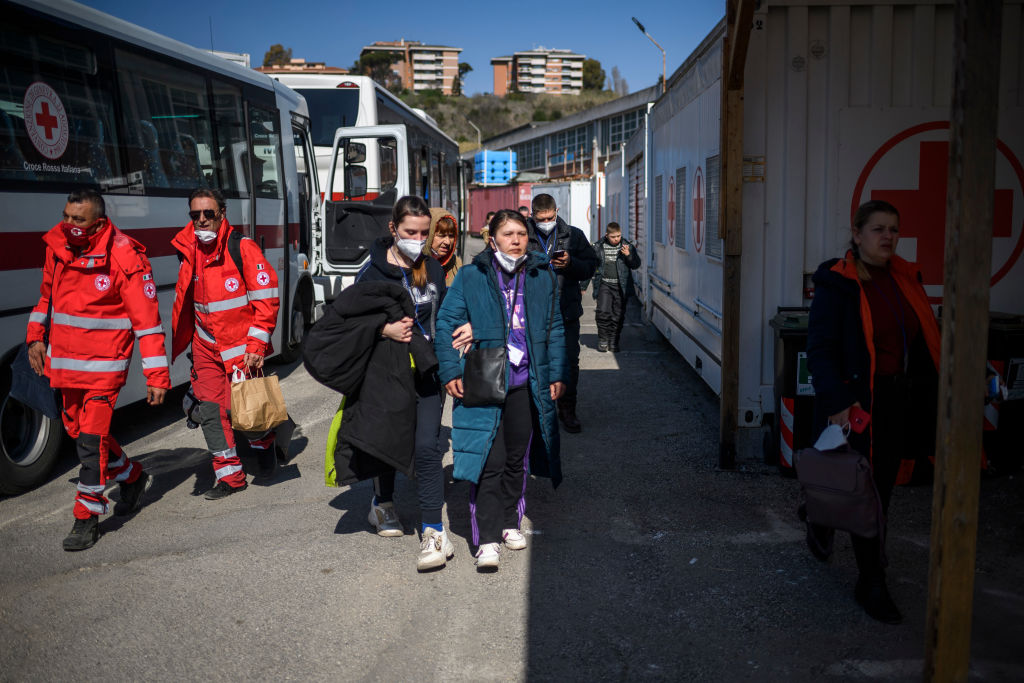
Refugees from Ukraine evacuated from Lviv by the Italian Red Cross arrive to Rome, Italy on March 22, 2022. (Antonio Masiello / Getty Images)
“Mariam” is an eighteen-year-old Moroccan, and was studying in the Ukrainian city of Kharkiv when Vladimir Putin’s forces invaded. She and a friend, “Yahya,” twenty-three, hid in an underground metro station, hearing the terrible pounding of Russian bombs in close proximity. “It was like a dream,” she recalled. Stuffing two small suitcases with the bare essentials, the friends boarded a train and fled west to Poland, then Berlin, then Rome, where their difficulties began in earnest.
Emergency numbers didn’t connect. Accommodation was expensive, and drained their savings. Having been told they qualified for temporary EU residency, they tried to find shelter at a Ukrainian Orthodox church on Rome’s outskirts, where Ukrainians were packing huge trucks with medicine and supplies to be transported to the Polish border — only to be turned away because they weren’t Ukrainian citizens. It was the same polite rejection that would become familiar over the course of an exhausting month at refugee shelters, police stations, government agencies: Sorry, we sympathize with your plight, but we can’t help you here.
Since late February, some two hundred thousand non-Ukrainian refugees have escaped Russian bombs and bullets and headed westward for a brief reprieve. For those who avoid outright racism and abuse at Ukraine’s borders — a fate also suffered by many in the country’s sizable Roma community — the EU offers something more blandly insidious. Having escaped a country at war, they face a slow grind through an unnavigable system that is fundamentally hostile to outsiders, presenting hope and despair in equal measure.