Why the Three Internationals Couldn’t Agree
On April 2, 1922, reformists and revolutionaries from three rival internationals met in Berlin in a bid to agree to a common program. Ending in failure, it was the last time for decades that Communists and Social Democrats would meet as ostensible comrades.
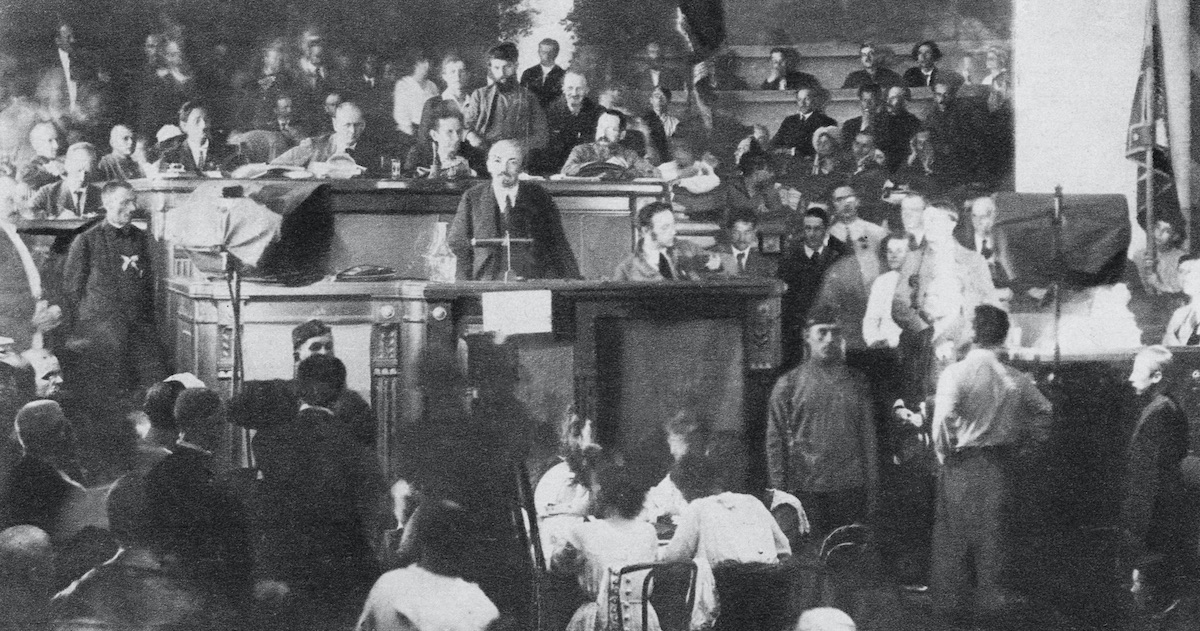
Bolshevik leader Vladimir Lenin speaks at the Second International Congress in 1920. (Hulton-Deutsch Collection / CORBIS via Getty Images)
For most of the twentieth century, the workers’ movement was divided into two distinct camps. Though both social democracy and communism traced their origins to the original International Workingmen’s Association, founded in London in 1864 by Karl Marx and other radicals, by the 1920s, the two currents had hardened into rival organizations and worldviews. After World War II, they represented opposite sides of the Cold War. By the 1990s, communism as a mass movement had all but disappeared, while social democracy, though still a significant political force, had long ceased to be a working-class movement.
Such an anticlimactic ending was unthinkable for socialists a hundred years ago. Whether reformist social democrats like Tom Shaw of Britain’s Labour Party, revolutionary Marxists like the Bolshevik Karl Radek, or those somewhere in between like Austrian socialist Friedrich Adler, socialism was the only conceivable horizon for humanity’s future. The movement had gone from conspiratorial circles to parties with millions of supporters in the span of two generations. The recent world war, which cost Europe 40 million lives and untold destruction, had heightened contradictions across the continent and brought socialists to power in several countries — in Russia through violent revolution, in Germany and Austria through the ballot box.
Yet the war had also brought the tension between reformists and revolutionaries to a head. What had once been a single movement now splintered into several feuding camps whose disunity weakened both sides and made them vulnerable to co-optation by their enemies. It was against this backdrop that, on April 2, 1922, three delegations assembled in Berlin in the Reichstag, the seat of the German parliament. As Austrian socialist Otto Bauer put it, the aim was to “bring together the three armies into which the proletariat has been unfortunately divided, so that they may be able once more to march together against the common enemy, and, united, defeat that enemy.”