How China’s Labor Migrants Write Poetry in the Workshop of the World
The labor of hundreds of millions of rural-to-urban migrants has spurred China’s incredible levels of growth. This social transformation has birthed a tradition of migrant worker poetry, documenting the hardship of the workers behind China’s economic miracle.
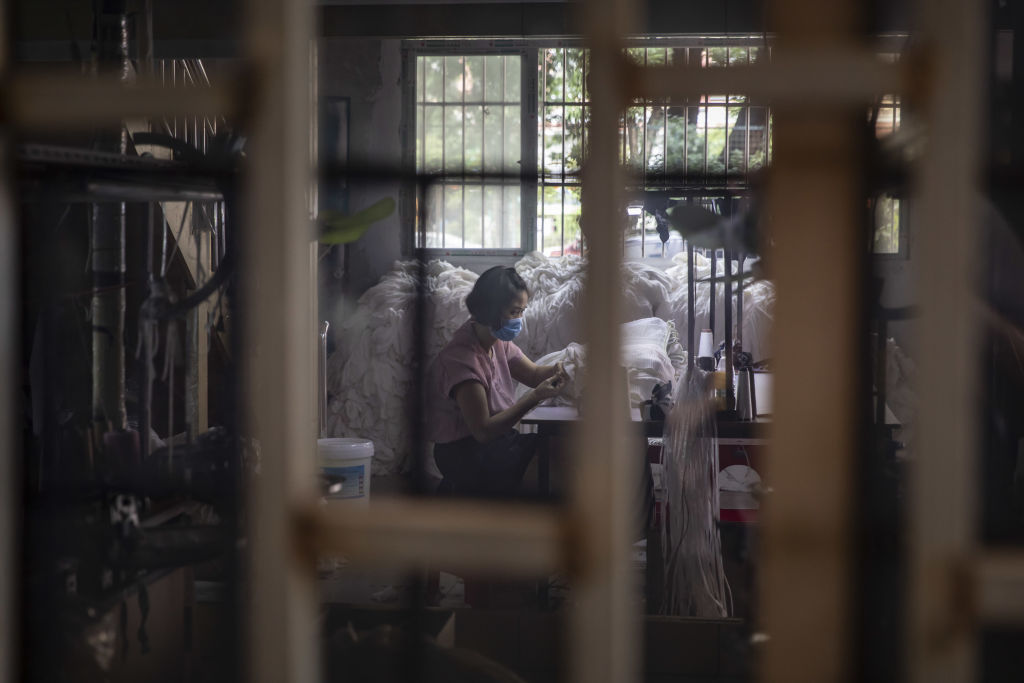
A woman works in a textile factory in the Pearl River Delta industrial belt. (Qilai Shen / Bloomberg via Getty Images)
Time’s giant beak yawns moonlight on the machine / turns to rust . . . she sits in her seat / the products flowing by interlock with time swallow it down so quickly / she’s old now . . . for many years she has stood guard / over the screws one screw another screw turn to the left turn to the right / fixing her dreams and her youth to a product watching / her pallid youth running always from the rural backland / to a city on the seaboard then to a store shelf in the US / exhaustion and workplace disease pile up in her lungs / stick in her throat her period no longer on time / her coughing fierce . . . the machines around her / are shaking she kneads her eyes red and swollen then takes her self / and sticks it in between the products flowing by
Sticking your self, or what’s left of it, in between the products on the assembly line is the perfect image of alienation. A woman from the Chinese countryside is sucked into the factory workshop, becomes the lifeless export product she is made to assemble, and ends up thoroughly displaced and for sale. This chilling scene comes from Zheng Xiaoqiong’s “Woman Worker: Youth Fixed to a Seat,” the opening poem in Stories of Women Workers (Nügong ji, 2012). (This essay draws on my work on battler poetry since 2017. All translations are mine.)
A labor migrant from Sichuan province, Zheng spent close to a decade on the assembly line in Southeast China’s Pearl River Delta, also known as the “Workshop of the World.” She is the face of China’s battler poetry and Stories is a landmark book. With the incisive empathy of an insider, it documents the suffering of female migrant workers and their resilience.