We Can Revive the Labor Movement. But It Won’t Be Simple.
Revitalizing the labor movement will never happen with one weird trick — it will require both top-down and bottom-up strategies in unions.
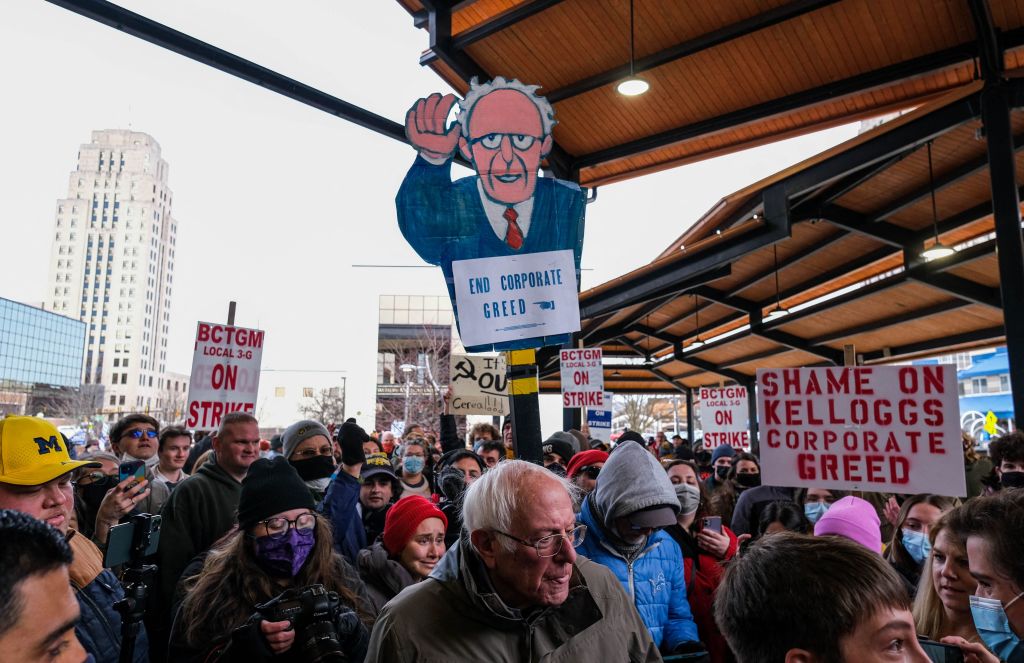
Senator Bernie Sanders makes his way through the crowd after speaking to striking Kellogg’s workers in downtown Battle Creek, Michigan, on December 17, 2021. (Seth Herald /AFP via Getty Images)
The uptick in organized and unorganized labor militancy registered throughout the pandemic, and in particular in strike and unionization campaigns in recent months, comes at a relative nadir for the US labor movement. The work of Kim Voss, professor of sociology at UC Berkeley, brings the current moment into sharper focus against the longer and particular histories of worker organization in the United States — from nineteenth-century workers’ organizations to more recent alliances between unions and social movements.
Voss’s 1993 book, The Making of American Exceptionalism: The Knights of Labor and Class Formation in the Nineteenth Century, argues against theories that attribute the labor movement’s weak and conservative character to factors like the individualist nature of American culture or the structure of the American economy. In doing so, she follows in the tradition of scholars like Werner Sombart, who emphasize the historical contingency of capitalist development. Voss traces the divergence between the American labor movement and its European counterparts to 1886, when powerful employers coordinated with the state to crush the progressive Knights of Labor.
Her later work focuses primarily on strategies for union revitalization; the 2004 book Rebuilding Labor: Organizing and Organizers in the New Union Movement, coedited with Ruth Milkman, considers the state of union democracy, conditions of membership recruitment, effectiveness of union leadership, and degree of anti-union sentiment among contemporary workers. Hard Work: Remaking the American Labor Movement, published the same year and coauthored with Rick Fantasia, focuses on the emergence of “social movement unionism” in cities like Los Angeles and Las Vegas, arguing that even in hostile terrain, trade unions that form strong community ties and are able to integrate labor demands with broader social aims may have a hopeful path forward.