The Rise of the Technocrats Has Pushed Italian Democracy Deeper into Crisis
Today, Italian lawmakers begin electing a new president. The president is often seen as a neutral referee standing above politics — but calls for ex–central banker Mario Draghi to take the job show how pro-market dogmas have been hardwired into public life.
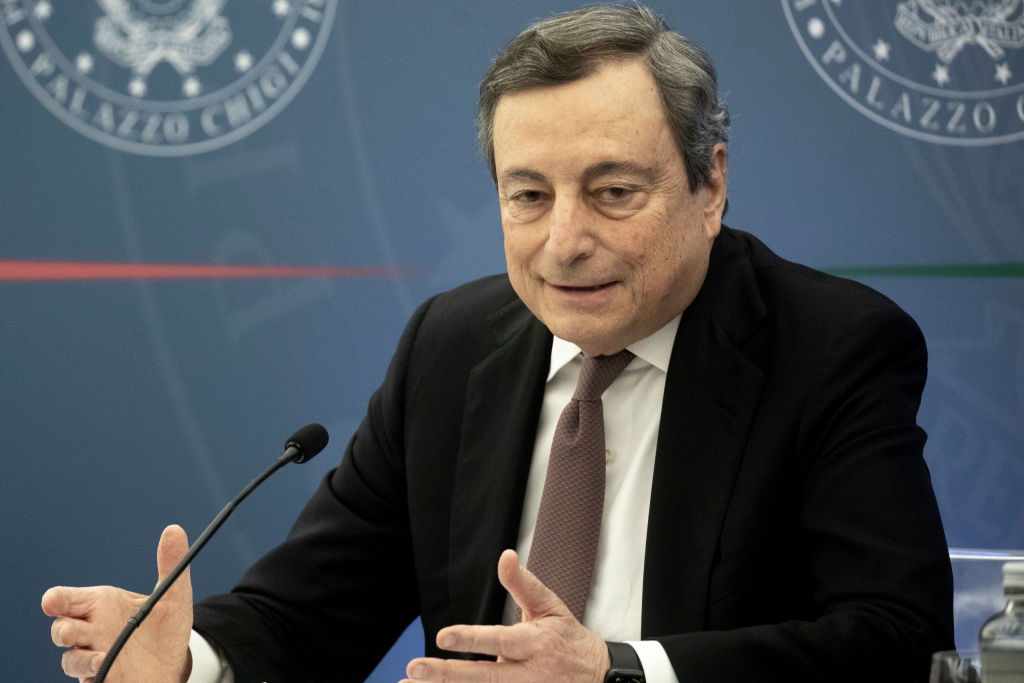
Italy’s prime minister, Mario Draghi, speaks to media during a press conference on January 10, 2022, in Rome, Italy. (Alessandra Benedetti / Corbis via Getty Images)
Crises are supposed to be moments of transition, with a beginning and an end. But in Italian politics, a crisis that began some thirty years ago continues apace. After the fall of the Berlin Wall and the “Bribesville” corruption scandal that brought down the old party system in the early 1990s, Italy entered a state of constant turmoil amid Silvio Berlusconi’s antics, financial crisis, and populist insurgencies interspersed with technocratic governments. Some on the Left, like 1998–2000 prime minister Massimo D’Alema, hoped that Italy would become “a normal country” like the European partners he and his colleagues so admired. Instead, its chaos intensified — while providing a foretaste of later developments across much of the West.
The political theater surrounding the election of the next president of the Republic, which begins on Monday, encapsulates this sorry state of affairs. The vote among MPs, senators, and regional electors to choose the new head of state has always been delicate business, but only in recent times has it become seen, and represented in Italian media, as a national emergency. At stake, we hear, is the future “stability” of the Italian Republic — meaning, its credibility vis-à-vis the European Union and investors. The result remains highly unpredictable, and amid all sorts of tactical moves, the ground is also being prepared for a general election to be held by 2023, in which the Right hopes to win an absolute majority.
According to custom — and given the deference attached to the institution — normally, no one explicitly puts their own name forward. Clever hopefuls tend to be those who act in a more reserved manner, awaiting the call of destiny. Yet, reflecting the anomalous character of this election, this time around two personalities have made clear their intentions to become president: Silvio Berlusconi and current prime minister Mario Draghi.