Italy’s New Technocratic Government Is an Insult to Democracy
The Italian president has appointed former European Central Bank chief Mario Draghi to form a "nonpolitical" government. In fact, this is the latest in a string of technocratic administrations designed to impose unpopular austerity measures — a deeply ideological program that Italians have never voted for.
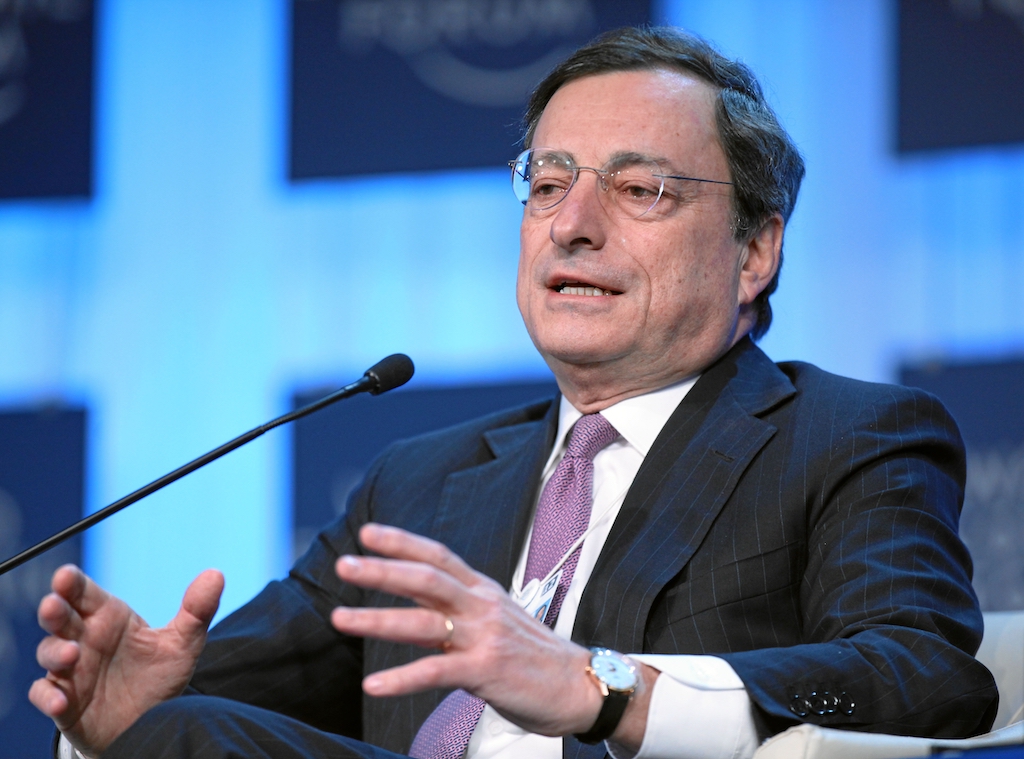
Mario Draghi at the World Economic Forum, 2012. (Wikimedia Commons)
Italy has long been the laboratory for all sorts of reactionary experiments, from Benito Mussolini’s Fascist regime to Silvio Berlusconi’s celebrity right-wing populism, a precursor to Donald Trump. In recent decades the belpaese has also become the testing ground for the most extreme form of neoliberalism: technocratic governments led by austerity-minded economists. It has been less than a decade since the government led by Goldman Sachs advisor Mario Monti enforced painful austerity measures against the popular will. Now, the Italian political establishment is at it again — in redoubled form.
To solve the political stalemate in incumbent premier Giuseppe Conte’s coalition, president Sergio Mattarella has tasked none other than former European Central Bank head Mario Draghi to form a new administration. Draghi is one of the architects of European austerity — and the person responsible for the memoranda that have devastated the Greek economy.
Draghi’s appointment — made with no reference to any kind of election or even the main parties — repeats the same old cure of “fiscal responsibility” designed to improve Italy’s “international reputation.” But it’s also something else. In the aftermath of the pandemic, it is also an attempt by business circles to lay their hands on the European Recovery Fund investment — directing it toward the business sector, rather than helping ordinary people.