To End Hyperexploitation, Seasonal Workers Need Union Solidarity
In October, Australia introduced a new visa for seasonal agricultural workers that is supposed to create pathways to permanent residency. But history shows that seasonal workers can only guarantee their rights if they're organized into fighting unions.
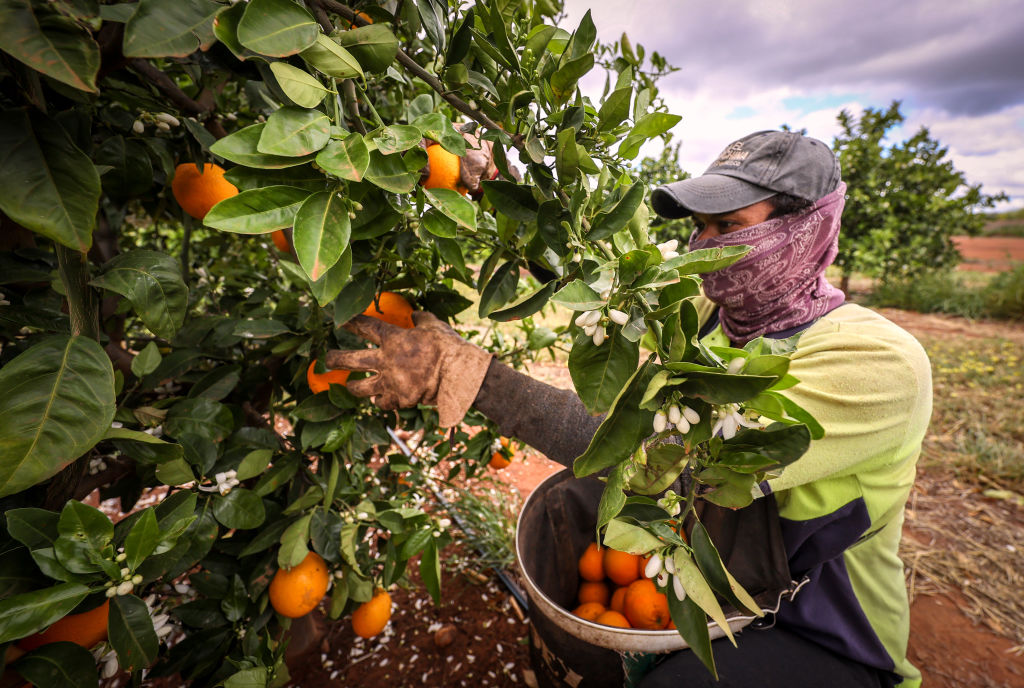
A seasonal worker harvests Valencia oranges from a tree at an orchard near Griffith, New South Wales, Australia. (David Gray / Bloomberg via Getty Images)
On October 1 of this year, the federal government announced a new agricultural worker visa designed to give Australian farmers access to laborers from countries that are part of the Association of Southeast Asian Nations. Known as the “Ag Visa,” the new arrangement is supposed to complement existing visa arrangements, like the Seasonal Workers’ Program (SWP) and the Pacific Labour Scheme (PLS). More specifically, it is supposed to compensate for the shortfall of laborers that resulted from recent changes to the Working Holiday Maker following recent negotiations concluded between Australia and the UK.
The federal minister for agriculture, David Littleproud, declared that this constitutes the “biggest structural change to agricultural workforce in our nation’s history.” What makes it so vastly different from the SWP and PLS is that it not only grants workers a limited ability to move between employers, but also a pathway to permanent residency. However, Michele O’Neill from the Australian Council of Trade Unions has condemned the arrangement as introducing a “second-class workforce.”
While these fears are well grounded, the new arrangements may also open opportunities for union organization and industrial action. Indeed, there are some signs that the tide is beginning to turn for agricultural workers in Australia. In November, the Fair Work Commission ruled to abolish piece rates in the horticultural sector, guaranteeing that thousands of workers who were systematically underpaid will now receive the minimum wage. To push the struggle even further, and protect against the creation of a new population of hyperexploited migrant workers, unions should look to the successful models of organization already operating in the sector.