The Fight for Italian Reunification Inspired the International Left
The first meeting of the Italian parliament in Rome, 150 years ago today, was a symbolic show of national reunification. Yet the battle against foreign domination had raised sharply contrasting ideas of the future Italy — leaving a lasting impact on socialists worldwide.
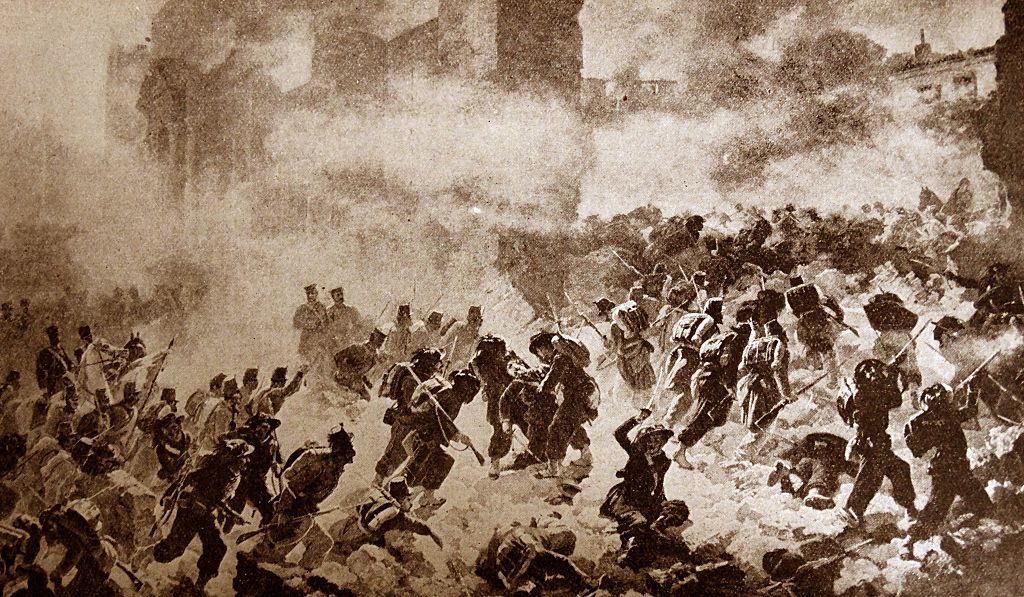
A painting depicts a scene from the Risorgimento, the political and social movement that consolidated different states of the Italian peninsula into the single state of the Kingdom of Italy in the nineteenth century. (Universal History Archive / Universal Images Group via Getty Images)
On November 27, 1871, Italy’s King Vittorio Emanuele II gave an impassioned speech at the Italian parliament, finally ushering in the complete unification of his country. For centuries, the peninsula had been divided into a patchwork of regions, mostly dominated by the monarchies of Austria, France, and Spain. Napoleon had worked to change this arrangement after the French Revolution, but, after Habsburg diplomat Count Klemens von Metternich’s reversal of his reforms at the Council of Vienna in 1815, the three foreign dynasties largely regained their strongholds.
In reaction came an aggressive Italian political movement, reintroducing the long-held concept of Risorgimento — national resurgence. In the 1830s, it was spearheaded by Genoa-born intellectual Giuseppe Mazzini, attracting thousands of young Italians at home and abroad. Above all, they wanted to see the European empires leave the country. Giuseppe Garibaldi, an important disciple of Mazzini’s and a member of the Young Italy secret society, stayed in touch with the Genoan for many years and, in 1848, heeded his call to return home and fight. In the meantime, Garibaldi made his name as an important guerrilla leader in South America — a man who knew how to lead a large merchant crew, or an army.
But things didn’t go as Mazzini had forecast. He had written Garibaldi that the huge Austrian army in the north of Italy was in a state of near collapse. Traveling through the north months afterward, Garibaldi found just the opposite was true, and the Italian forces were heavily defeated in the Battle of Novara against Habsburg opposition. As for Mazzini, by March 1849, he was appointed to the three-man tribunal running a radical republic in Rome that had just been created. From the start, everyone agreed, Mazzini was very much the lead man.