“Economic Freedom” Rankings Don’t Tell Us Anything About Capitalism
Conservatives and libertarians love to cite studies ranking different countries’ levels of “economic freedom” as evidence for the glories of capitalism. There’s just one problem: the rankings are nonsense.
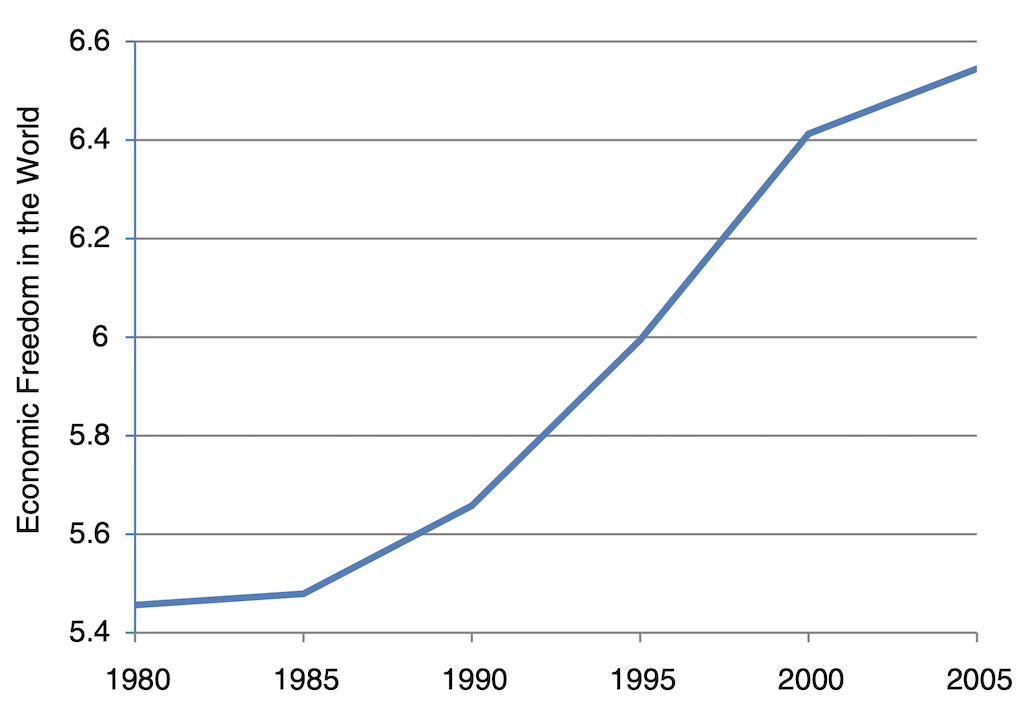
Economist Peter Leeson’s graph titled “The growth of capitalism globally.” (Springer)
Last month, the Fraser Institute put out its annual Economic Freedom of the World report. As usual, it showed that “economic freedom” is positively correlated with many good things and negatively correlated with many bad ones.
Defenders of capitalism love the Fraser Institute. Libertarian philosopher Jason Brennan, for example, has made heavy use of the rankings in the context of criticizing the arguments of Marxist philosopher G. A. Cohen. Brennan argues that given all the positive things that come with greater economic freedom, the debate about whether capitalism is superior to socialism has a clear victor: the pro-capitalist side. The only remaining question is whether socialism would be better in a hypothetical world where humans were less selfish and lazy.
Economist Peter Leeson has deployed the Fraser Institute’s reports to mount an even more strident defense of capitalism Many commentators, Leeson writes, think that capitalism deserves “two cheers” for yielding many good outcomes while also thinking that “excessive” or “uncontrolled” capitalism can be bad. Leeson says this is wrong because the Fraser Institute’s numbers show that capitalism deserves three cheers.