The War on Terror Militarized America More Than Ever
The War on Terror projected American power abroad with devastating consequences. But it also wrought suffering and waste at home, with consequences we’re still living with today.
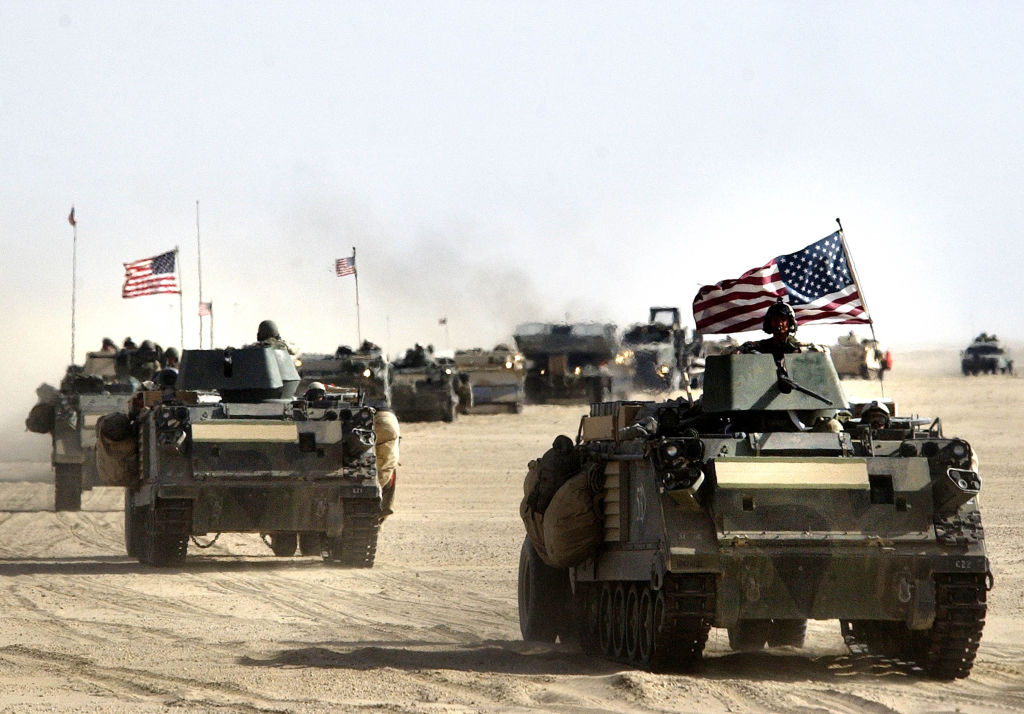
US Army ahead of a possible military strike near the Kuwait-Iraq border, 2003. (Scott Nelson / Getty Images)
According to a recently published report from the Institute for Policy Studies (IPC), America has spent a whopping $21 trillion on militarization since 9/11. It’s an astonishing figure, so large it can be difficult to comprehend. Here, the report’s authors offer some useful clarity: militarization, they argue, should be understood as a domestic process as well as a series of foreign interventions funded by direct spending on tanks, machine guns, and cruise missiles. The so-called “war on terror,” after all, also brought with it a sprawling new apparatus concerned with what is generally branded “domestic security”: allocating billions, under Democratic and Republican presidents alike, to areas like border administration and domestic surveillance.
Lindsay Koshgarian is the program director of the IPC’s National Priorities Project and a lead author of its new report “State of Insecurity: The Cost of Militarization Since 9/11.” In this interview, Koshgarian speaks with Jacobin about its calculations, and the alarming process of militarization undertaken since the September 11 attacks twenty years ago.
Luke Savage
Your top-line finding — that America has spent $21 trillion on militarization since 2001 — is quite breathtaking. Could you break it down for us and run through how exactly you got this figure and what it includes?
Lindsay Koshgarian