The Southern Slaveholders Dreamed of a Slaveholding Empire
Antebellum slaveholders weren't content with an economic and social system based on trafficking in human flesh in the South alone. They wanted to expand slaveholding territory outward, to the American West and even beyond the borders of the United States.
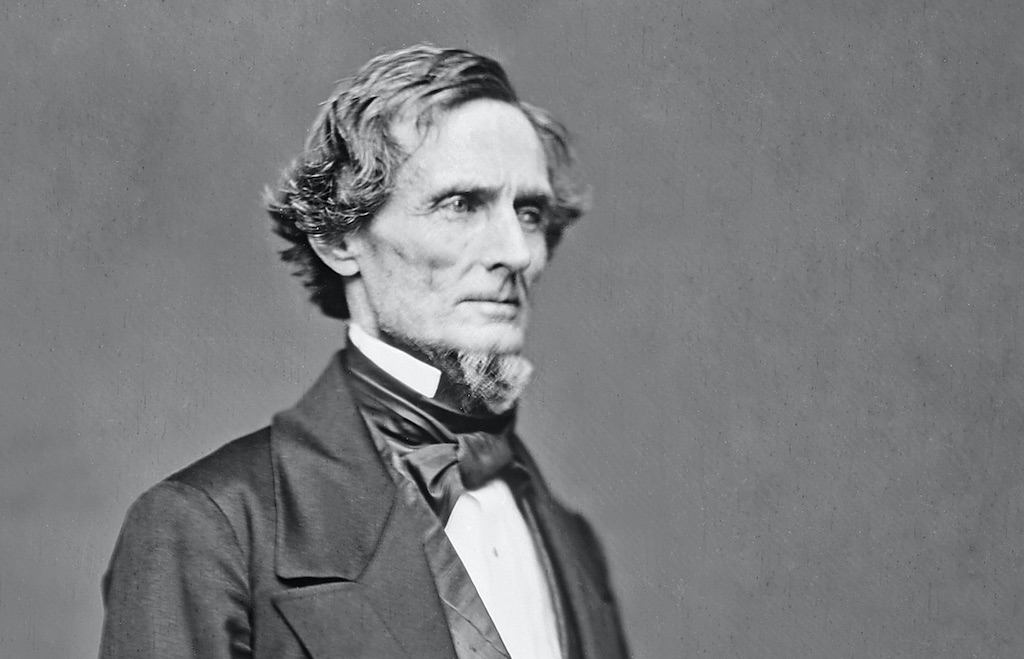
President of the Confederate States Jefferson Davis sought to build, with other slaveholders, a transcontinental slave empire, c. 1861. (Mathew Brady / National Archives)
In 1851, Jefferson Davis presented to his Senate colleagues a plan facilitating travel throughout the newly colonized southwestern United States. Three years earlier, the end of the Mexican-American War had brought a stretch of land from Texas to California under US control. But without a railroad or mail route tying the Atlantic to the Pacific, it remained difficult for the now transcontinental nation to connect across its vast expanses. Davis proposed what he saw as an ingenious solution: camels.
Although Davis was nearly laughed out of the Senate, his proposal was realized in 1855. Serving as secretary of war under president Franklin Pierce, Davis oversaw the import of roughly two hundred camels from North Africa and the Middle East for use in expeditions by the US Army and, he hoped, for both labor and trade. Despite some success, the camel corps was abandoned by 1860 after Congress refused further funding, due in part to escalating tensions that would be unleashed by the Civil War the following year.
More than a historical oddity, the camel corps is a testament to the imperial designs of Southern slaveholders. Far from being cloistered regional elites, Southern slaveholders like Davis — later the president of the Confederate States of America — looked outward, beyond the South, and worked to enlist the federal government (and Northern accomplices, such as Pierce) in their brazen effort to build a transcontinental slave empire.