When British Workers Stood Against the Pinochet Coup
When Chile’s generals overthrew Salvador Allende on September 11, 1973, Britain’s Tories welcomed the coup as good news for investors. But British trade unions worked to block trade with the newly empowered Chilean fascists.
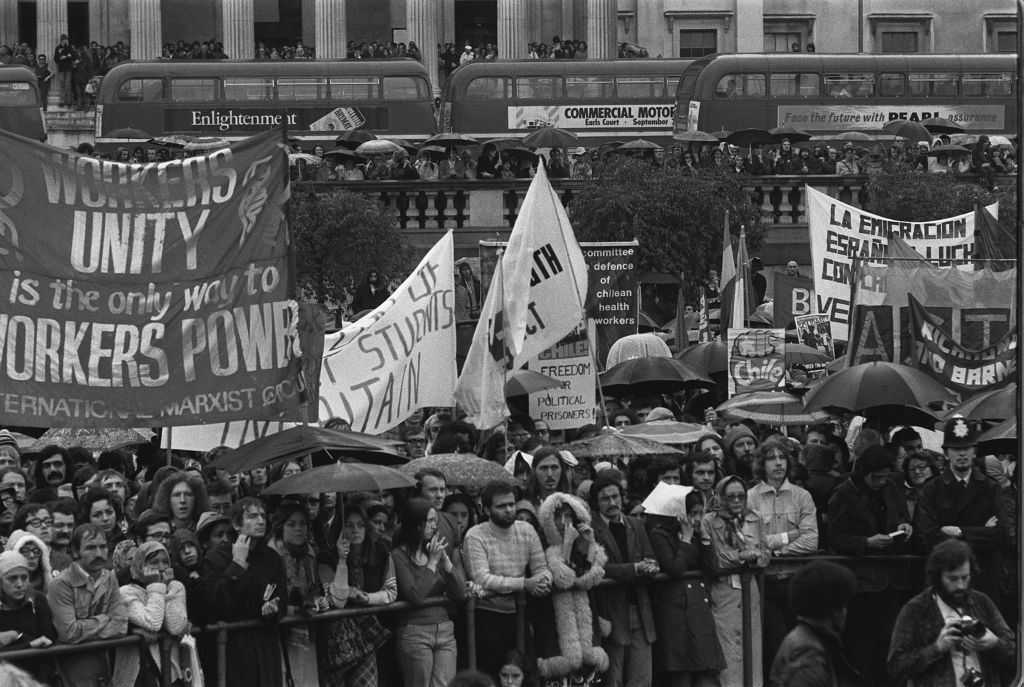
A rally organized by the Chile Solidarity Campaign, addressed by the widow of Salvador Allende, in Trafalgar Square, London, September 1974. (PA Images via Getty Images)
“For British interests . . . there is no doubt that Chile under the junta is a better prospect than Allende’s chaotic road to socialism, [and] our investments should do better.” Writing ten days after the military coup against Salvador Allende’s Popular Unity government in Chile, UK foreign secretary Alec Douglas-Home provided an optimistic assessment of general Augusto Pinochet’s putsch and the bloody reassertion of capitalist hegemony. But if Douglas-Home spoke for many in the British ruling class, his country’s labor movement did not share his attitude toward the new junta. As organized labor saw things, its “interests” were aligned not with investors but with the working-class Popular Unity supporters who now faced torture and murder in the Pinochet regime’s prisons.
Indeed, the coup d’état of September 11, 1973, and its aftermath, as the new US-backed regime acted upon its declared intent to “eradicate” the “Marxist cancer,” horrified many in Britain’s trade-union movement — helping to stir a campaign of practical solidarity with the people of Chile. The reaction was all the more heartfelt because Allende’s government had pursued a democratic socialist program, and many of those persecuted following the military takeover were fellow activists in left-wing parties and trade unions. Labour MP Eric Heffer, who had met Allende on a 1972 delegation to Chile, “wept unashamedly” upon receiving news that the attempt he had witnessed “to achieve socialism through the Parliamentary process” had been “murdered.”
The hurried organization of a Chile solidarity movement in the UK exasperated the efforts of successive British governments to maintain relations with the junta. Abhorrence at Pinochet’s atrocities in Britain was not limited to the socialist left — many liberals and church groups came to oppose the regime on humanitarian grounds. But it was the distinctly left-wing Chile Solidarity Campaign (CSC), with its founding leadership associated with the Communist Party, that constituted the foremost anti-Pinochet voice in British civil society, through its broad-based work among the labor movement.