Dirty Work Shows the Toll Bad Jobs Take on the People Who Do Them
Capitalism has created a world full of bad and brutal jobs, from meatpackers to drone operators. Capitalists created these jobs — only organized workers can get rid of them.
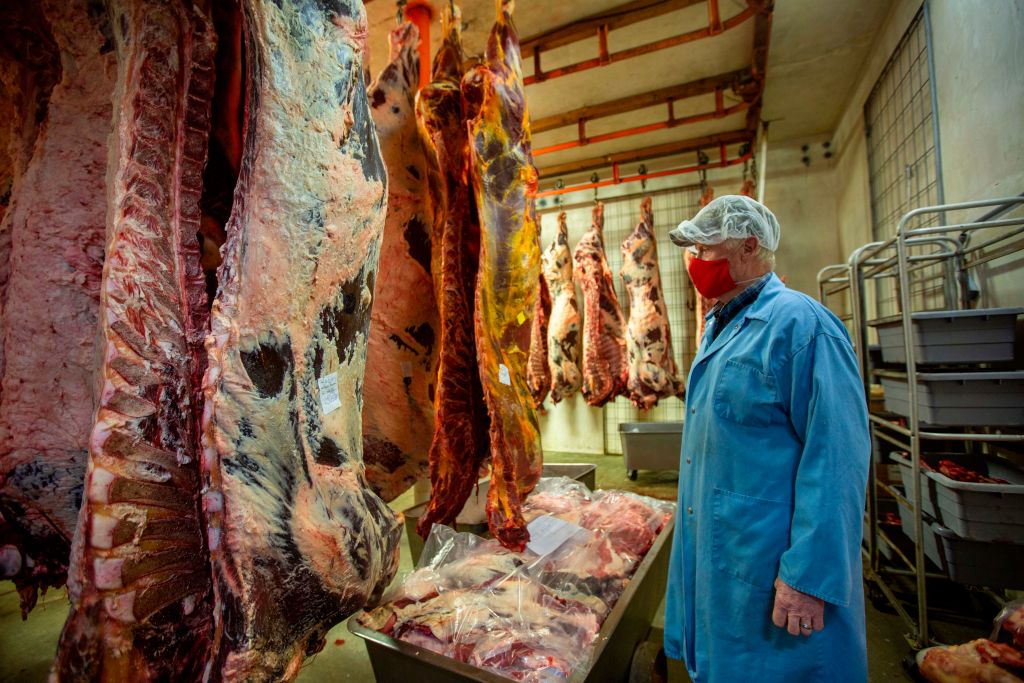
People who work in slaughterhouses are among the people Eyal Press classifies as doing “dirty work.” (Natalie Behring / AFP via Getty Images)
Darren Rainey was an inmate at the Dade Correctional Institution in Miami-Dade County, Florida. He suffered from schizophrenia and was housed in the Transitional Care Unit (TCU), the prison’s mental health ward. In June 2012, Rainey supposedly defecated in his cell and wouldn’t clean it up. The prison’s guards placed him in a shower and directed scalding water at him through a rigged-up hose. The water’s temperature was 180 degrees Fahrenheit. Rainey died with burns on 90 percent of his body, and skin that fell off at the touch. A fellow prisoner, Harold Hempstead, whose cell was below the shower where Rainey was killed, later said he heard Rainey scream repeatedly and kick the door of the stall. Then, he heard a thud — Rainey collapsing, dead.
In Dirty Work: Essential Jobs and the Hidden Toll of Inequality in America, Eyal Press — no relation to me, so far as I’m aware — introduces Rainey’s story by way of Harriet Krzykowski, who was a mental health counselor in the TCU at the time of his death. Before the torture took place, Krzykowski had asked a guard about Rainey on his last day alive and was told the guards would give him a shower, the danger of which she was not aware. The next day, upon learning from nurses on the ward how Rainey had died, Krzykowski was “stunned,” writes Press. “Surely, she told the nurses, the incident would prompt a criminal investigation.”
The nurses swiftly corrected her, explaining that the torture would be covered up.