Bosses Shouldn’t Be Able to Close Factories Whenever They Feel Like It
US labor law is so stacked against workers it allows companies to pack up and leave just to avoid dealing with a unionized workforce. We shouldn’t give employers this nuclear option — it completely undercuts working-class power.
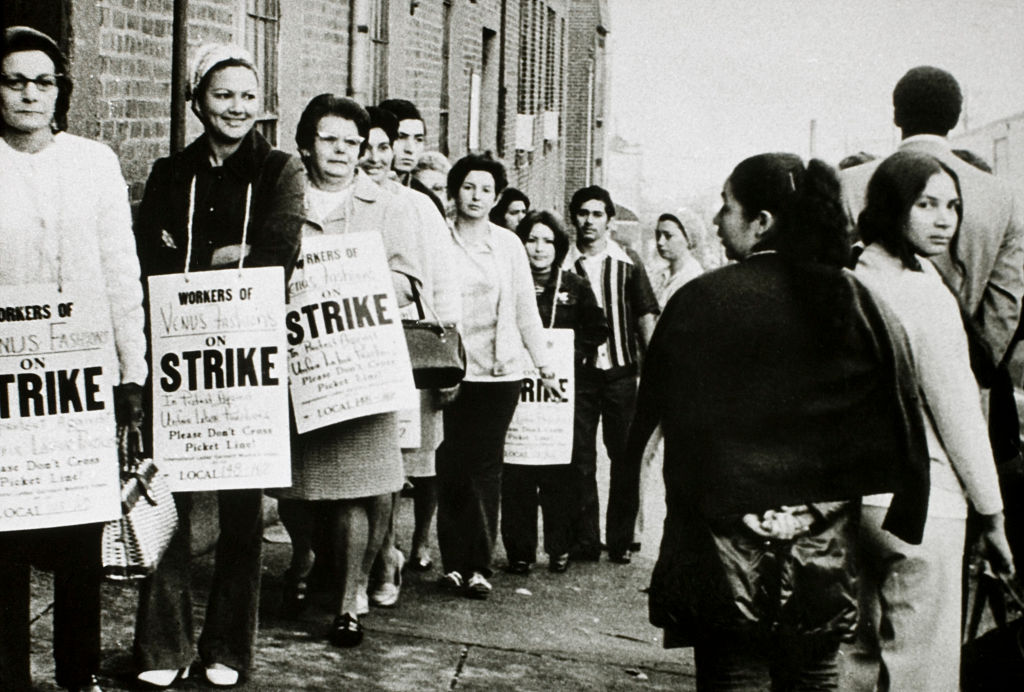
International Ladies Garment Workers Union Local 149 on a picket, c. 1960. (Universal History Archive / Universal Images Group via Getty Images)
There is no more high-stakes situation in federal labor law than the “runaway shop” case. Traditionally, this is where an employer closes an organized facility and opens at a new location with nonunion employees, whether in retaliation for a union’s win in an election, consistent strike activity, aggressive posturing at the bargaining table, or any number of protected activities. It is the nuclear bomb of unlawful employer actions; the result is a destruction of union jobs and the upending of the very purpose of the National Labor Relations Act (NLRA), which was created to bring “industrial democracy” to the American workplace.
Suffice it to say, how the National Labor Relations Board (NLRB) treats these cases is of paramount importance. And even the most casual observer of labor law knows that the approach has been completely inadequate. As professor Cynthia Estlund once pointed out, the vast majority of anti-union activity in these “capital allocation” matters can be easily cloaked in the neutral language of rational economic decision-making, and the penalties for the rare employer that fails to hide its anti-union intent are largely toothless. Much of this dilemma can be traced back to the Labor Board’s saga in Garwin Corp., 153 NLRB 664 (1965), in which the agency briefly tried to tackle this issue head-on before acquiescing to judicial opposition.
The facts of the case are not complicated. Garwin was a small clothing manufacturer in Queens, New York, that specialized in printing swimsuit designs. The company’s fifty-some employees were represented by a particularly militant local of the International Ladies Garment Workers Union beginning in 1961. After two years of contentious relations with the union at the bargaining table and on the shop floor, the two men who ran Garwin sought to move their business to Miami and leave their labor troubles behind them. During the annual summer downtime when the shop usually remained closed for weeks, management snuck the machinery out of the Queens shop and shipped it to Florida, where an alter-ego outfit by the name of S’Agaro, Inc. immediately put it to use with nonunion labor.