Hillary Clinton Wants Nina Turner to Lose
The special election in Ohio’s 11th congressional district, where Hillary Clinton and the Democratic establishment are struggling to defeat former Bernie Sanders surrogate Nina Turner, is the latest illustration of how Democratic elites prioritize defeating the Left over strengthening their own party.
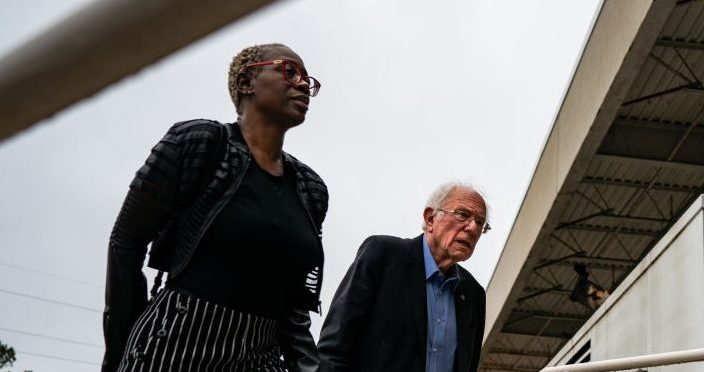
Nina Turner and Bernie Sanders on February 26, 2020 in Myrtle Beach, South Carolina. (Salwan Georges / Washington Post via Getty Images)
When Hillary Clinton endorsed Shontel Brown’s candidacy in the Ohio 11th congressional district’s special election last month, there was an obvious personal dimension and a noticeable amount of pettiness involved. Nina Turner, Brown’s primary opponent (and, by all appearances, the race’s front-runner), played a significant role as cochair of Bernie Sanders’s 2020 presidential campaign and was a vocal supporter during his 2016 challenge to Clinton. The narrative of a relitigation of the 2016 primaries spawned by Clinton’s intervention has predictably come to color national perceptions of the race. But this development risks obscuring the wider dynamic at play.
Last week, Brown secured another high-profile endorsement from none other than Jim Clyburn, the third-ranking Democrat in the House of Representatives, a development that is striking for a number of reasons. As the New York Times noted in its reporting on the race, the congressman rarely intervenes in primary contests. In publicly justifying the move, Clyburn invoked his by-now-familiar opposition to what he called the “sloganeering” of the Democratic Party’s left wing — citing as an example, among other things, the issue of Medicare for All.
As Julia Rock and David Sirota of the Daily Poster have observed, Clyburn actually cosponsored Medicare for All legislation when it was first introduced in 2017, before ultimately coming to vilify it a few years later. His stated reason was that the issue would hurt Democrats electorally, though it’s hard not to think that the more than $1 million he’s received in donations from Big Pharma — an amount that, as of last year, put him firmly ahead of other members of Congress — may have had something to do with it.