Indonesia’s Carnival of Democracy
Leftist politics in Indonesia have languished ever since the anticommunist massacres of the 1960s. The recent general elections were no exception.
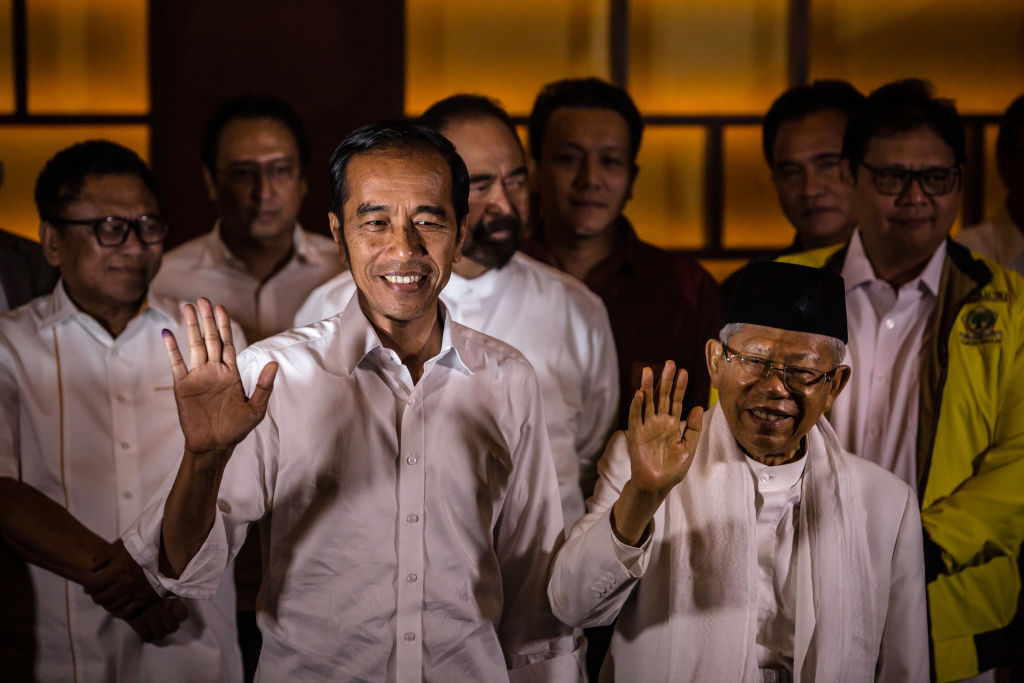
Indonesian incumbent presidential candidate Joko Widodo and his vice-presidential candidate Maruf Amin (R), wave during press conference after general election on April 17, 2019 in Jakarta, Indonesia. Ulet Ifansasti / Getty
In the lead-up to Indonesia’s recent general election, the international media focused on the eye-watering complexity of the contest: over 196 million registered voters; over 17,000 islands, spread over 3,300 miles of the equator; 250,000 candidates; 20,000 seats in play — and all carried out in less than an eight-hour day. Since the election more than four hundred polling officials have died from exhaustion during the still-incomplete counting process. With just under 80 percent of the ballots tabulated, it looks like incumbent Joko Widodo (“Jokowi”) will be returning to the presidential palace.
So, after all this effort, will it be more of the same for the world’s largest Muslim majority nation? The same slow erosion of democratic reforms won before and after Major General Suharto’s fall in the late 1990s? Ever higher levels of inequality as this industrializing and urbanizing economy continues to grow apace? More religious conservatism while progressive politics languishes on the fringe?
The Results
If the leaders of the large English-speaking economies ever stopped to survey Indonesia, they might be more than a little surprised — perhaps even jealous — at the relative stability. While the US rides the roller-coaster of Trumpian politics, the UK drowns in Brexit, and Australia prepares to move on to its eighth prime minister in less than a dozen years, Jokowi is readying himself for his second five-year term. When he completes it, Indonesia will have had just two leaders in two decades.