Italy’s Government Is Outsourcing Its Economic Strategy To Private Management Consultants McKinsey
Last month, former European Central Bank chief Mario Draghi formed a new government whose top ministries were handed to unelected technocrats. Now his "government of experts" has outsourced its economic plan to private management consultants McKinsey — without voters having ever had any say in the matter.
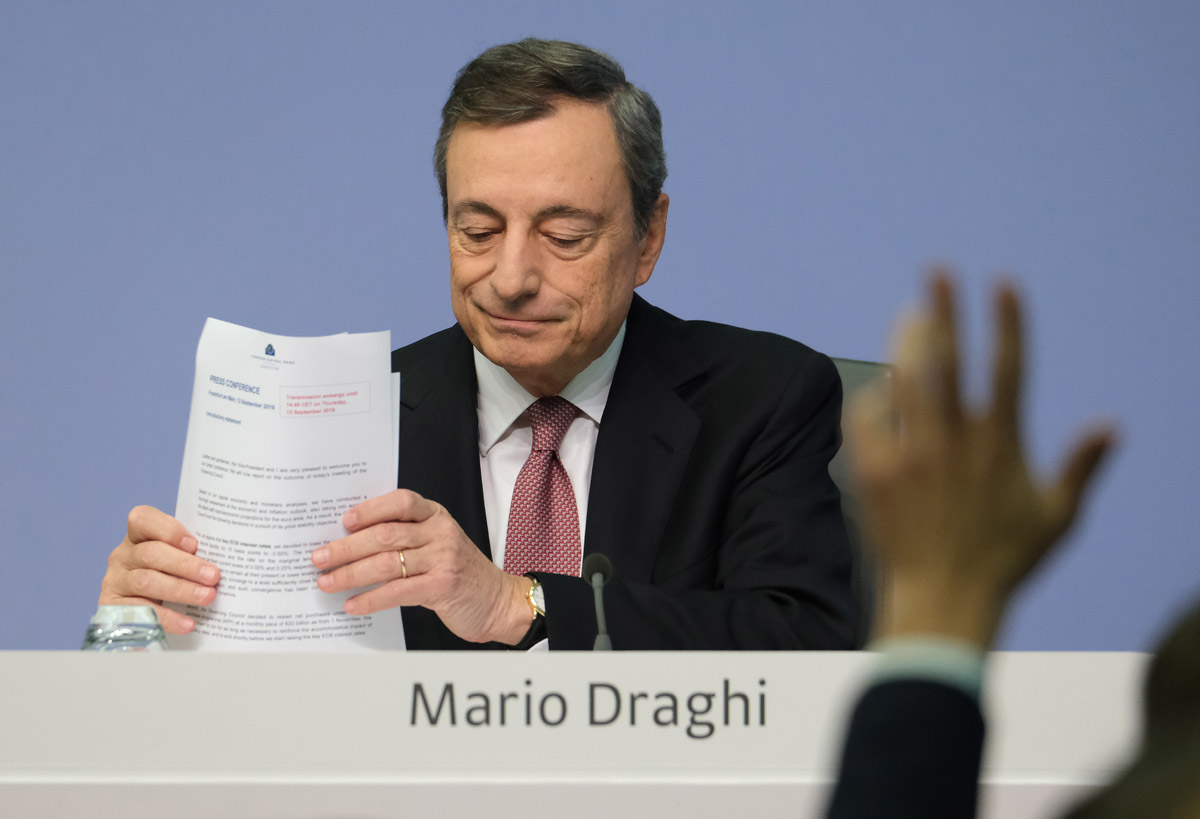
Mario Draghi, then-president of the European Central Bank, prepares to answer a reporter’s question following a meeting of the ECB governing board on September 12, 2019 in Frankfurt, Germany. (Sean Gallup / Getty Images)
Upon its formation last month, Mario Draghi’s new government was heralded by almost all Italian and international media as a rescue operation. Where the former European Central Bank (ECB) chief Draghi had “saved the euro” in the 2010s, most outlets gushed over “Super Mario” and his plan to “save Italy” by splashing a mooted €209 billion in European recovery fund cash while “reforming” its lackluster economy.
The kind of “reforms” this meant went unmentioned — and after all, this government bears no relation to voter decisions, or the coalitions that ran in the last general election. But for the fourth time since the 1990s, a president called on a technocrat from the world of finance and banking to form a cabinet, halfway through a parliament. Eight of Draghi’s twenty-three ministers are unelected technocrats, in a so-called government of experts.
If these figures are not party-political, they have similar backgrounds and instincts. Economy minister Daniele Franco is a former Bank of Italy official who drafted the famous 2011 ECB letter instructing the government to implement privatizations and cut back collective bargaining. Former Vodafone CEO Vittorio Colao — today innovation and digital transition minister — is a former partner at private consultants McKinsey & Company.