The Dutch Left’s Collapse Shows How It Failed to Politicize the Pandemic
On Wednesday, the Netherlands held Europe's first national election since the start of the pandemic — and the entire center-left took just 20 percent of the vote. While the crisis provided a chance to call for radical economic change, the "post-ideological" center-left posed no alternative to the government's call to return to normal.
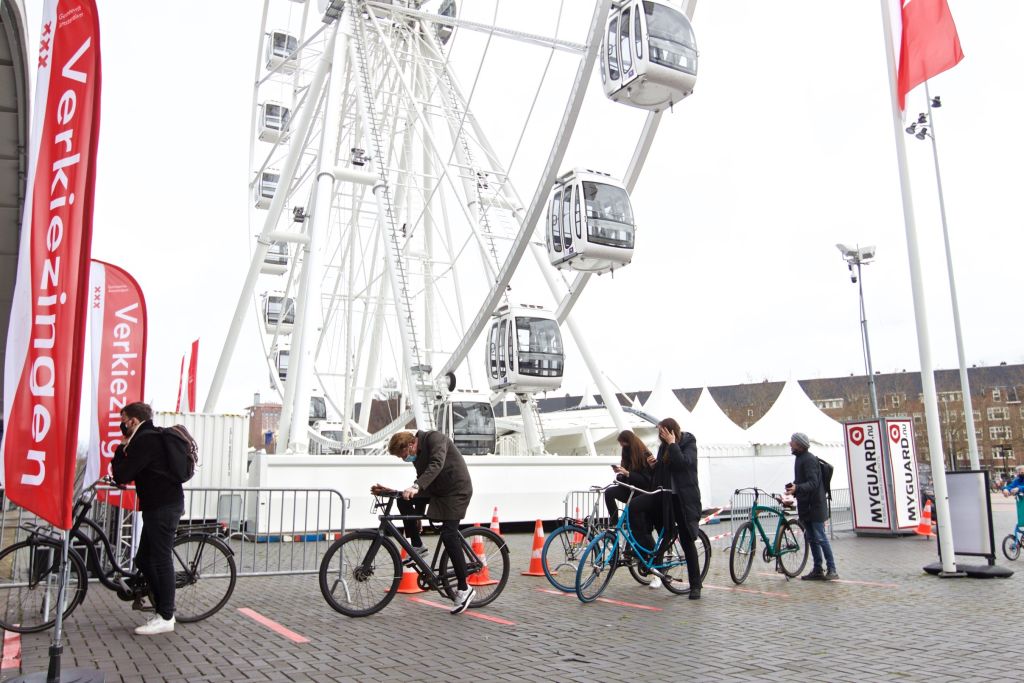
Bike-riding voters wait to cast their ballots at a polling station in Amsterdam on March 17, 2021. (Xinhua/Sylvia Lederer via Getty Images)
“At its core, the Netherlands is a center-right country,” says incumbent prime minister Mark Rutte. It’s March 17, election night, and Rutte’s hard-right People’s Party for Freedom and Democracy (VVD) has just won its fourth election in a row. In the first national elections in Europe since the start of the pandemic, both the governing center-right coalition and the populist far right consolidated their positions. The Dutch center-left, in decline for over a decade, received only one-fifth of the total vote.
Rutte is right, at least when it comes to these elections: the country by and large voted in support of his center-right government and there were net gains for the four coalition parties, who together took 79 out of 150 seats, up from the 2017 contest. Besides Rutte’s VVD, at 35 seats, coalition partner D66 — a liberal center-right party — also profited from being in government, taking 24 seats. Their government’s collapse over a racist anti-benefit fraud policy scandal two months ago seems not to have bothered their voters in the least. The result means that VVD and D66 will likely form the core of the next coalition government, with one or two other centrist or left-wing parties.
While there is no minimum threshold for election to the national parliament, this contest brought a level of fragmentation unique even by Dutch standards. A record number of seventeen parties, five newcomers among them, will enter the 150-seat lower house at the end of March. This also means that the dwindling support for the progressive wing of Dutch politics is now spread out over five minor (center-)left parties, jointly amassing just 32 seats: SP (socialist), GroenLinks (green left), PvdA (social democratic), PvdD (Party for the Animals), and the radical-left newcomer BIJ1 (“together”).