Workers Deserve Beautiful, Renovated, Even Luxurious Public Housing
This year's Pritzker Prize, the highest award in architecture, went to French architects who rejected the demolition of public housing. Instead, the architects insisted on renovating and expanding public units to make working-class residents' homes more modern, humane, and attractive.
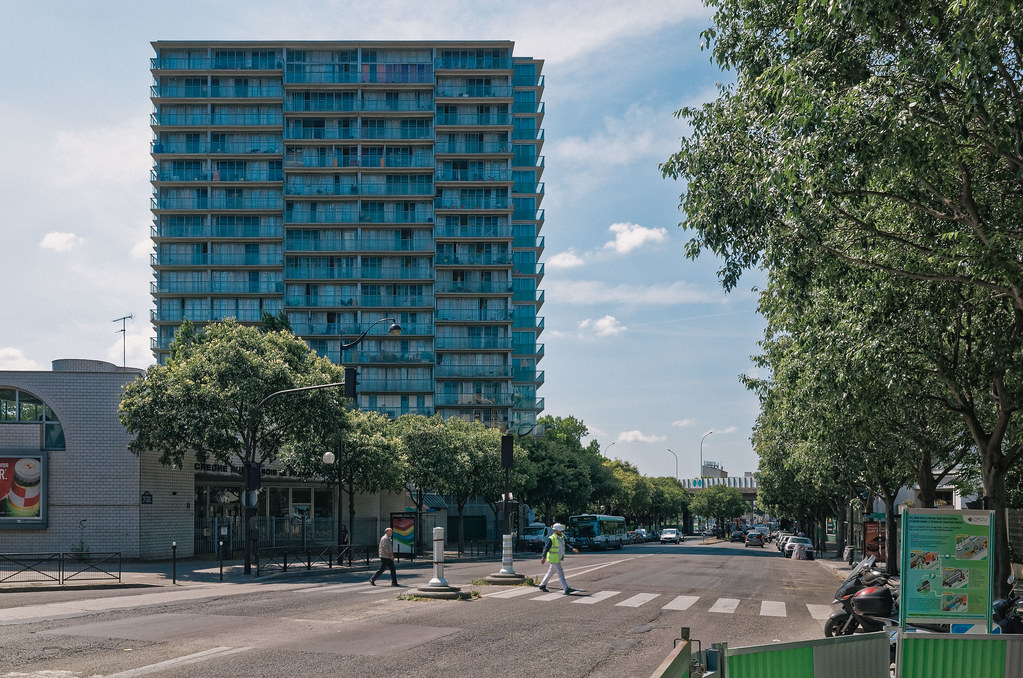
The Tour Bois-le-Prêtre, the apartment block renovation by Frédéric Druot, Anne Lacaton, and Jean Philippe Vassal, in Paris, France. (Flickr)
It was just coincidence that I saw the two stories on the same day. On the Twitter account of Phineas Harper, director of the architecture charity Open House, I saw that two perfectly decent blocks of council housing on the south bank of the Thames in the center of London were slated for demolition. One is a decorative brick tower of flats, which was originally built for nurses, and the other is a London County Council slab block, similar to those built in the Alton Estate in Roehampton, based on the work of Le Corbusier.
Each of them is fine architecture, in a dense area already dominated by blocks of flats yet where affordable housing is seriously scarce. There could be no possible explanation for their demolition on architectural or social grounds — the only explanations would be monetary (a council, here Lambeth, selling up to avoid running out of cash) or political (an opposition to the notion of council housing — let alone just opposite Parliament).
The other story was that the Pritzker Prize, the annual award that is, roughly speaking, architecture’s Nobel Prize, had been awarded to Anne Lacaton and Jean-Philippe Vassal, a French duo who have come to specialize in renovating postwar public housing.