In 2009, Pundits Predicted a New Progressive Era. It Never Came.
We’ll have to wait to find out whether Joe Biden’s domestic agenda will actually reflect the surprisingly progressive noises he’s been making since his swearing in. But the exultant days and weeks surrounding Barack Obama’s inauguration offer a cautionary tale.
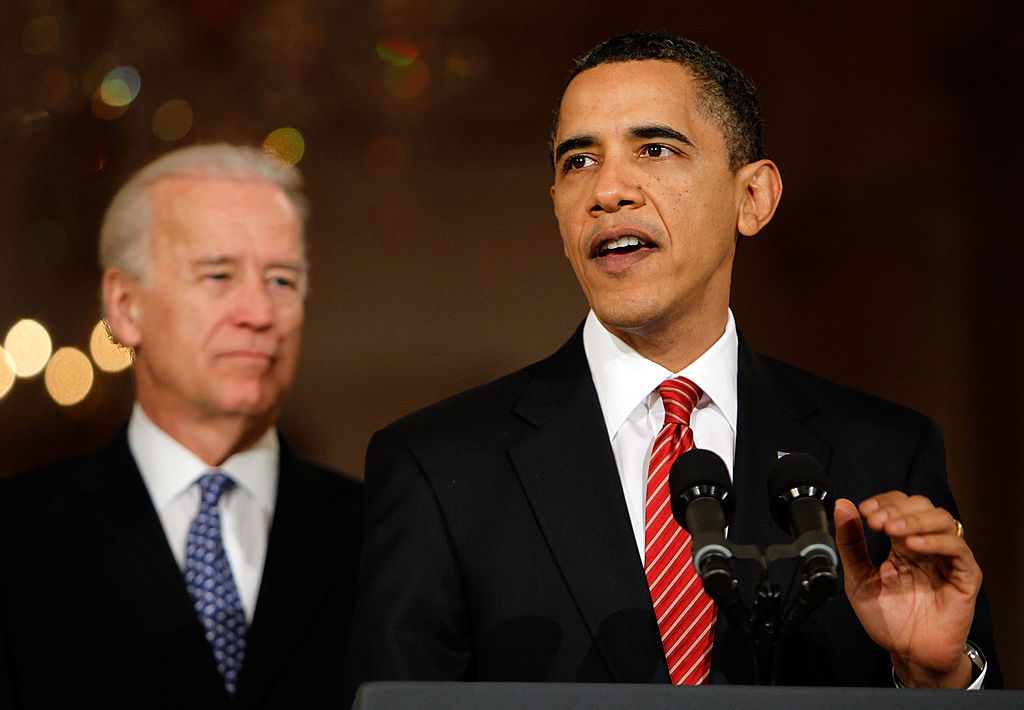
US President Barack Obama speaks as Vice President Joseph Biden listens at the White House in March, 2009. (Alex Wong / Getty Images)
Just ahead of his inauguration, Joe Biden released the details of a stimulus package that is almost certain to represent the most consequential legislative item of his first year in office. On its face at least, the plan is clearly more ambitious than the one that emerged in the early days of the Obama presidency. Coming in at nearly $2 trillion, today’s bill, if passed as written, would be more than a third larger than its 2009 equivalent — representing not only a break with decades of fiscal orthodoxy but also with Biden’s own past as an especially vocal deficit hawk.
As Paul Heideman recently explained in Jacobin, Biden’s newfound boldness reflects a wider shift in the business consensus around public deficits (the US Chamber of Commerce, for example, has actually endorsed Biden’s COVID rescue bill in spite of its $1.9 trillion price tag). True to form, Biden has also indicated that he wants to seek bipartisan support for the deal. Still, his apparently unabashed embrace of large scale public spending certainly leaves the impression of a president preparing to govern to the left of the last two Democratic administrations, at least on the domestic policy front. As the Huffington Post’s Zach Carter put it: “Despite [the] oddities and disappointments in Biden’s proposal, there is simply no denying that his program is more ambitious and progressive than the economic agenda of former President Barack Obama.”
We’ll know soon enough whether these initial impressions, encouraging as they seem, are borne out in practice. For the time being, however, they’ve added fuel to a narrative some pundits have been pushing since the Democratic primaries ended last spring: that Biden is positioned to become a transformative president in the mold of FDR or Lyndon B. Johnson (the latter being, like Biden, an especially unlikely figure to assume such a role).