Emmanuel Macron Is Creating a Liberalism Without Civil Liberties
On Tuesday, France's National Assembly passed a bill effectively banning citizens from posting videos of police officers. Emmanuel Macron is trampling on historic press freedoms in order to prove himself as a "law-and-order" president — an authoritarian turn which makes a mockery of his claimed defense of liberal values.
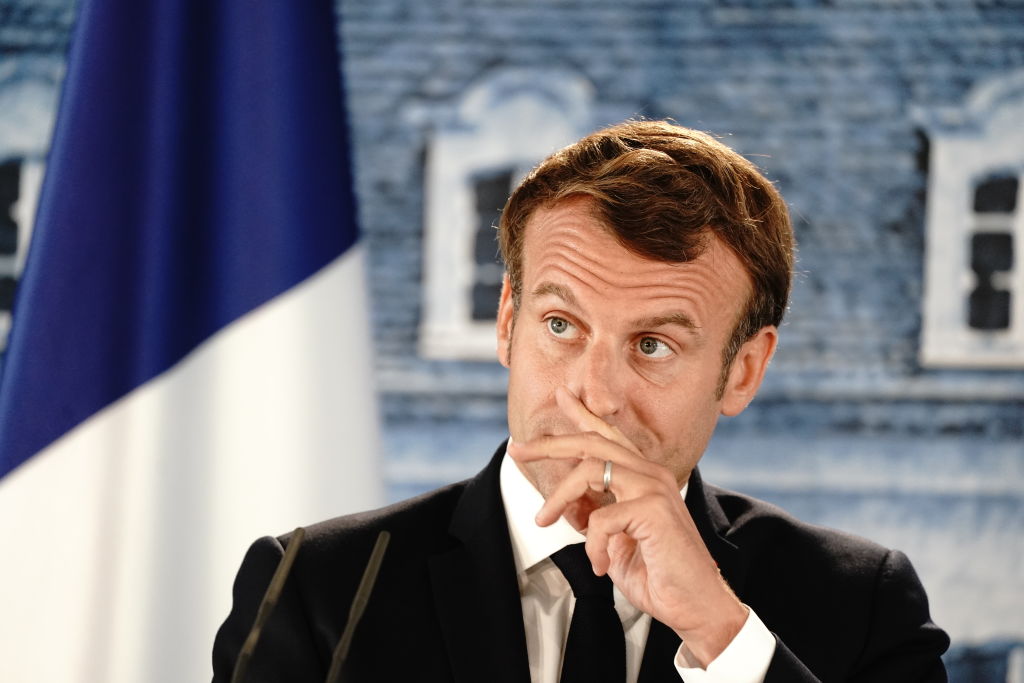
President Emmanuel Macron in Gransee, Germany, 2020. (Kay Nietfeld – Pool / Getty Images)
It reads like the sort of blunt attack on civil liberties you’d expect from the ruling party in Hong Kong or Turkey — certainly not anything that would pass muster in a country where politicians regularly invoke the Republic and its unrelenting commitment to liberal values. And yet, this is the reality of France’s sweeping new national security bill, approved by pro-Macron legislators in the National Assembly on Tuesday, and set to head to the Senate in January.
Under the legislation, law enforcement will gain a host of surveillance powers, like the expanded ability to use drones and deploy body cameras transmitting live feeds directly to police headquarters. But most alarmingly, the bill would make it illegal to publicly share images of police, if the officer in question can be identified and if the goal is to “manifestly” harm his or her “physical or mental integrity.” This extraordinarily vague offense would be punishable by a fine of up to €45,000 — and a year in prison.
In other words, publishing a video of a cop clubbing a protester, frisking a group of teenagers, or making an unnecessary traffic stop could soon come with the risk of jail time. This prospect has drawn the ire of the country’s journalist unions, left-wing parties, and NGOs like Amnesty International, but also France’s government-appointed rights ombudsman, and even the UN Human Rights Office.