The “Scarlet Runners” Women Were at the Center of New Zealand’s Six-Month-Long Miners’ Strike
1912 saw one of the biggest battles in New Zealand labor history, a six-month-long miners’ strike that paved the way for the general strike a year later. But it couldn’t have lasted so long without the working-class women who organized to defend their community — the “Scarlet Runners” who fought the strikebreakers.
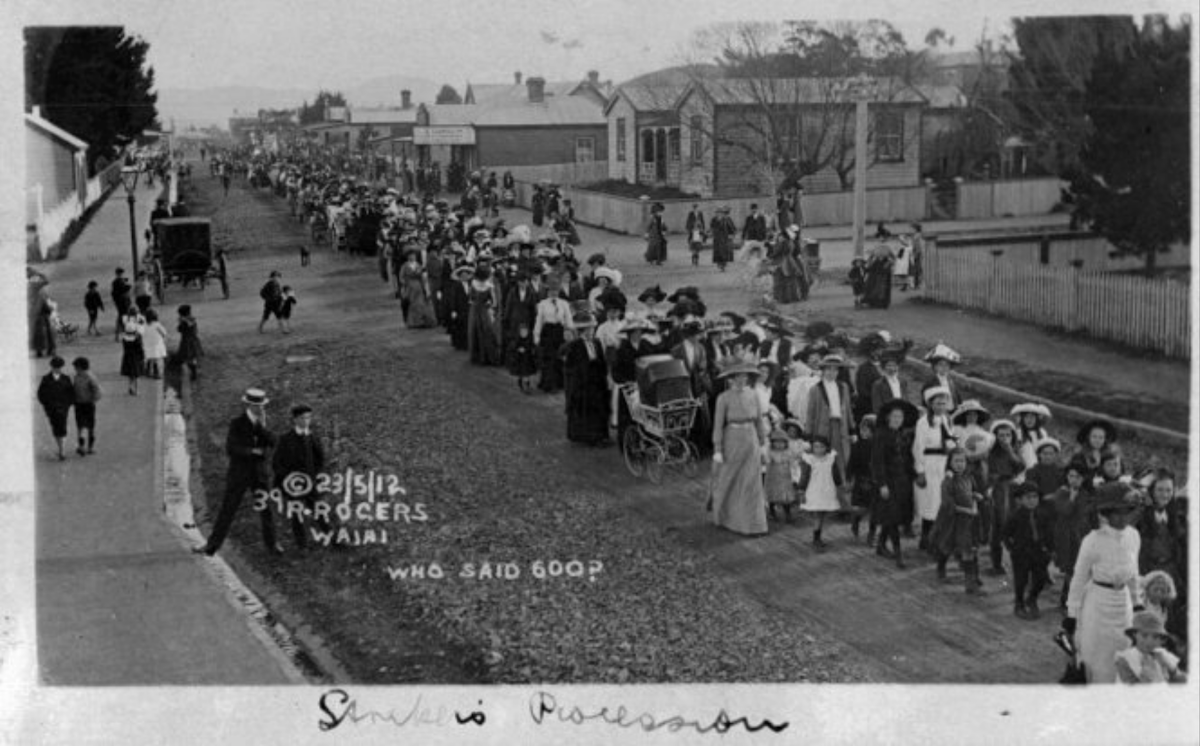
Women and children marching in Waihi, in support of the 1912 miners’ strike. The caption of the postcard reads “Who said 600?” in response to a report in the New Zealand Herald that there were only six hundred marchers. Photograph taken by R Rogers. (National Library of New Zealand)
“You dirty scabby bastard. I will tear your white liver out and belt you over the head with it.” This threat against strikebreakers was just one of hundreds of quotes recorded by police summing up the militant spirit of the “Scarlet Runners,” a group of women and girls who led the resistance in one of the most contentious strikes in New Zealand/Aotearoa history. They were active in the Waihi gold miners’ strike of 1912, a battle that lasted for six months, ending on “Black Tuesday” with the death of striking miner Fred Evans. The crisis it provoked laid the foundations for the General Strike the following year — and was a crucial step in the maturity of the country’s Labour Party.
Often, the role of women is missing from the industrial history of this era. But as part of a thriving socialist community, the women of Waihi overturned the gendered norms of wider society. From the 1890 Maritime Strike to winning female suffrage in 1893, in New Zealand, women were instrumental in key events. But resurrecting this history means not just mentioning women’s participation, but making labor history “as attentive to issues of gender as it is to issues of class.” In trying to preserve their family life, the Scarlet Runners’ story shows us how a strong community fighting for survival can become radicalized — even when fighting in an apparently conservative cause.
A Socialist Town
Today a quiet town of 4,500 people, a two hours’ drive south of Auckland, in 1912 Waihi was New Zealand’s second city. With a population of 6,500 thanks to employment opportunities at the gold mine, the town developed a vibrant, militant culture that centered around the Miners Union Hall. There was a socialist Sunday school for children, with some fifty pupils, and among them was sixteen-year-old schoolgirl Zena Norton. Demonstrating Waihi’s credentials as a socialist paradise was her entry to an essay competition on the meaning of the Union Jack, the British flag incorporated into this colony’s own: