St. Louis’s Shameful Workhouse Jail Must Be Shut Down
In St. Louis, the demand to defund the police has dovetailed with long-lasting struggles against cash bail and the abuse of prisoners. The Board of Aldermen’s passing of a bill that promises to start closing the city’s most notorious jail reflects the movement’s strength — but also the need for pressure to ensure that abolitionist demands are not watered down into merely cosmetic reforms.
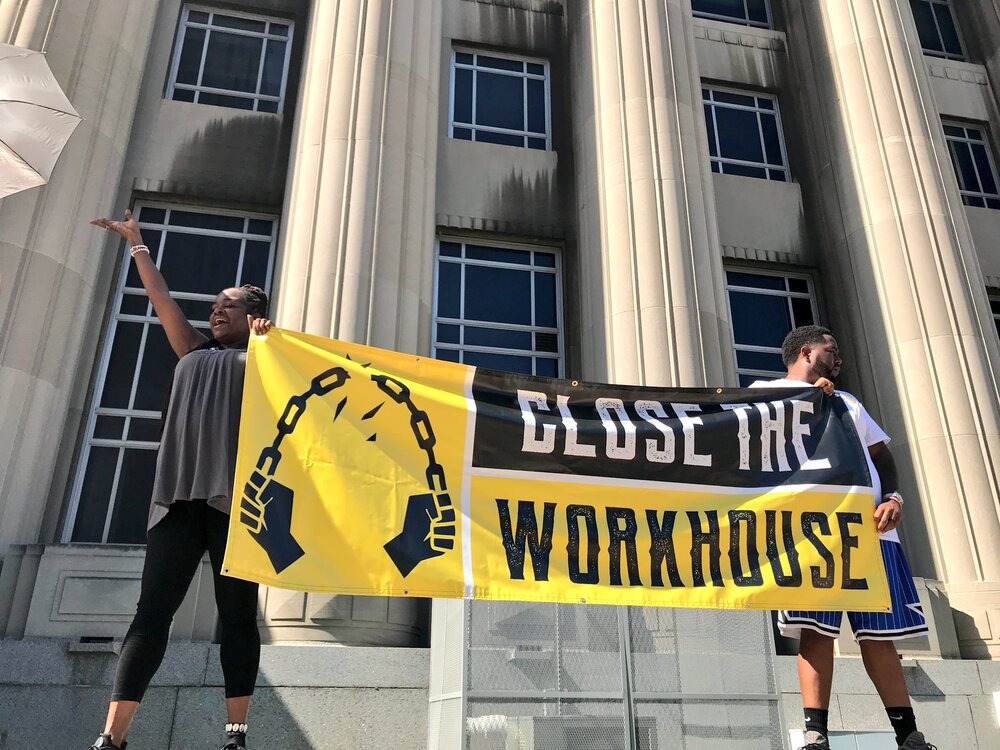
Members of the Close the Workhouse campaign hold a banner in St. Louis, Missouri.
On June 29, the president of the St. Louis Board of Aldermen, Lewis Reed, filed Board Bill 92 — a motion to begin a process to close the city’s notorious Workhouse jail and reinvest the funds elsewhere. The Workhouse effectively operates as a debtor’s prison: it almost exclusively cages legally innocent residents, i.e., “nonviolent offenders” pre-trial, indeed for an average of 290 days. Their only offense is that they can’t afford cash bail.
Formally called the Medium Security Institution (MSI), conditions in the Workhouse are squalid — and abusive. In 2009, the Missouri ACLU told of “endemic abuse of inmates” in the jail, reporting that guards regularly encouraged and organized fights among captives; in a 2013 survey of 358 jails by the Department of Justice, the Workhouse ranked third in reports of sexual misconduct by staff. The last five years have seen the death of six detainees inside the jail. Medical assistance is scarce at best, and outright neglect is common. In summer 2017, Heather Ann Thompson reported on the temperatures north of 110°F repeatedly endured by those trapped inside the Workhouse, without air conditioning. In one video, prisoners were heard crying out for help — after the footage went viral, protesters rallied outside the gates.
Conditions in the jail have long sparked uproar. “We must say, in no way did we discover these things for the first time,” Blake Strode of the nonprofit civil rights legal advocacy organization ArchCity Defenders told listeners of his podcast Under the Arch. “You can trace litigation against the Workhouse back to the 1970s. It was like the same things had been happening for decades.” Indeed, already in 1975, revered St. Louis activist Percy Green, then the chairman of ACTION (Action Committee to Improve Opportunities for Negroes), wrote an op-ed in sharp opposition to the expansion of the Workhouse through a city bond issuance.