The Many Explosions of Los Angeles in the 1960s
Mike Davis and Jon Wiener's chronicle of Los Angeles in the 1960s, Set the Night on Fire, isn't just a stunning portrait of a city in upheaval half a century ago. It's a history of uprisings for civil rights, against poverty, and for a better world that speaks directly to our current moment of mass protest.
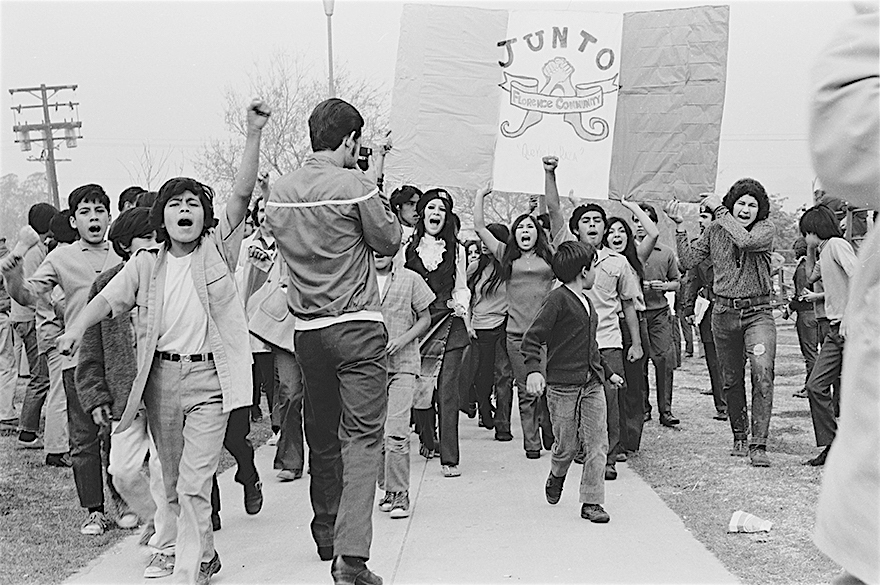
Youth from the Florencia barrio of South Central Los Angeles arrive at Belvedere Park for La Marcha Por La Justicia, on January31, 1971. (Luis C. Garza / UCLA Chicano Studies Research Center)
The vision of sun-drenched Los Angeles, the land of the forever young, tanned white beautiful people drinking and partying at the beach, so popularized by Randy Newman’s “I Love L.A.,” has from time to time been punctured by the much less rosy news appearing in the media about the doings of the city’s working-class population living on the other side of the tracks. Such news is not necessarily motivated by a concern for the poverty, homelessness, xenophobia, and racism those groups live under, but rather by the potential for mass protests and riots to break out, as they have throughout the city’s history. In the process, such coverage misses the molecular and less visible social and political forces that precede them and that explain their evolution and impact.
This is not a problem with Mike Davis and Jon Wiener’s monumental Set the Night on Fire: L.A. in the Sixties, the definitive treatment of the resistance against oppression and war by the “other LA” and their protest movements in the long 1960s (1960 to the mid-1970s). Theirs is a major, beautifully written 788-page opus, an exhaustive and in-depth presentation of the wide-ranging big and small resistance movements of that period with a sober and insightful account of their strengths and weaknesses, including the role that the political left played in them. Its publication in 2020 could not be more timely in these days when tens of thousands have been demonstrating in Los Angeles and across the country and world against police brutality and racism.
A City Dominated by Racist Repression
Davis and Wiener place the social and political movements of resistance in 1960s Los Angeles in the context of a political structure similar to many Southern cities of the period. While citing Malcolm X, Martin Luther King, and James Baldwin explicitly likening LA’s racist abuses of the sixties to those of Birmingham, Alabama, the city of that time was much richer and economically developed than Birmingham, and it included diverse leading economic sectors such as real estate (a developers’ paradise), considerable manufacturing including the highly technologically developed aerospace industry, banking, and entertainment.