Spain Needs Social Solidarity as Well as Social Distancing
Last month’s revelations of the Spanish monarchy’s illicit financial dealings embarrassed official claims that “we’re all in this together.” Faced with COVID-19, citizens are forced to build their own collective response — replacing the empty rhetoric of “national unity” with the real practice of social solidarity.
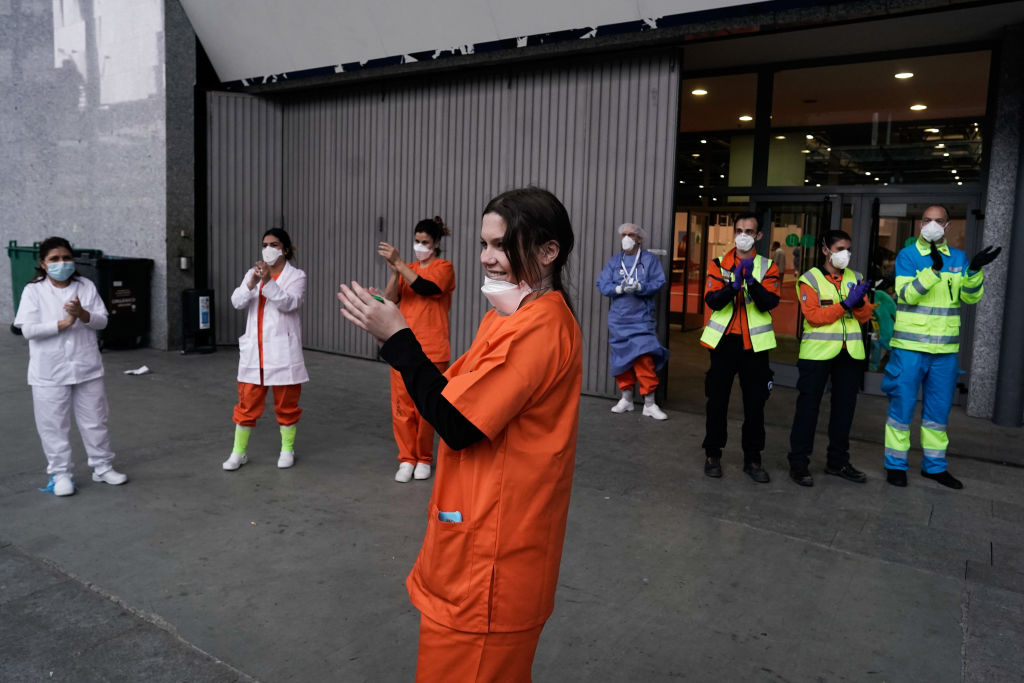
In this handout picture provided by Comunidad de Madrid, health workers applaud at Emergency Hospital IFEMA on March 31, 2020 in Madrid, Spain. Borja Sanchez-Trillo — Comunidad de Madrid Handout / Getty
I suppose it’s the same everywhere, but Spain’s coronavirus lockdown is difficult to describe with any clarity. Filter bubbles are no longer as buzzworthy as in 2016, but their walls thicken in confinement. Since the government officially announced a state of emergency and the order to stay at home on March 14, my window into the situation here has been the same as anybody else’s: daily government press conferences, twenty-four-hour news channels, the internet, dubious forwarded text messages and anecdotes from comrades, friends, and family. Those, and my actual window.
Thankfully, my small rental apartment in Barcelona has a balcony, where my wife and I can get some sunlight for a couple of hours in the afternoon when the weather is nice. We live on the corner of two small streets in a working-class neighborhood, a quiet place with the exception of one week every summer, when a massive block party surrounds us with clashing open-air concerts, irreverent papier mâché sculptures, colorful party banners, and busy beer stands — boisterous social proximity that seems alien now.
Over the last couple of weeks, though, I’ve come to realize that this was never such a quiet place at all. By removing the ambient white noise of traffic and the occasional whine of Vespas, the lockdown has revised my idea of “quiet.” Any sound outside is now brought into sharp relief. Every cough breeds a shiver. What was once indecipherable chatter now feels closer to theater or a radio play. I notice that the gently pulsating drone of houseflies, bees, and pigeons cooing near our balcony is periodically drowned out by the cackle of distant seagulls flying deeper and deeper into the city. There is still the rhythmic clanging of the ambulant butane salesmen, still the clatter of scrap metal collectors digging in the dumpsters, still no paid time off in the city’s starkly racialized informal economy.