Capital Swallows Itself
The crisis of capitalism is currently opening wide. But it didn’t come out of nowhere.
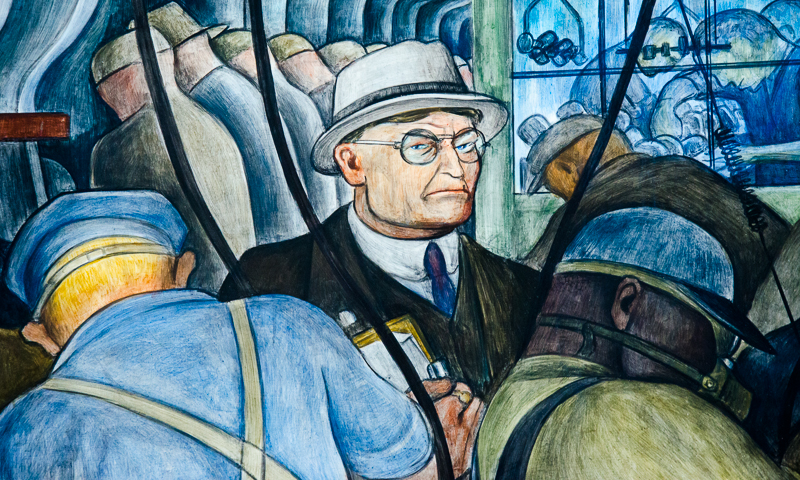
One of the “Detroit Industry” murals of 1932–33 by artist Diego Rivera.
Thinkers across the world have long pondered why the wealthiest nation in the world has often had the most unpredictable working-class responses to capitalism, from seeming passivity to volcanic explosions and back. Louis Adamic, a famed radical journalist of the 1930s–40s, speculated that individual acts of violence, the veritable sign of chaos, were the unique American marker. But how do we find the deeper causes?
No one is better qualified to speak to those causes than Steve Fraser. Fraser not only penned the totemic biography of garment union champion and industrial union founder Sidney Hillman, Labor Will Rule, but he has also poured equal energy into the histories of the other end of the class structure: the rise of the nineteenth-century industrial titans and their strategies to keep control of society at large, their own company empire in particular, and the often glum story that follows. His volumes Age of Acquiescence, Every Man a Speculator, Limousine Liberals, and Class Matters make Fraser what Corey Robin calls “our preeminent historian of America as a capitalist civilization.”
Fraser’s mission has been to fill out the class dynamics of that civilization, with a close study of the financial and industrial barons, but also on struggles from below. Mongrel Firebugs, a compendium of Fraser’s essays, reveals him speaking to both sides of American society in dynamic tension.