“Today’s Working-Class Heroes Should Be at the Heart of Tomorrow’s Society”
European leaders won’t consider debt cancellation or abandon the dogma of neoliberal austerity. Coronavirus shows that well-funded public services are essential for our survival — austerity is a matter of life and death. We need an alternative.
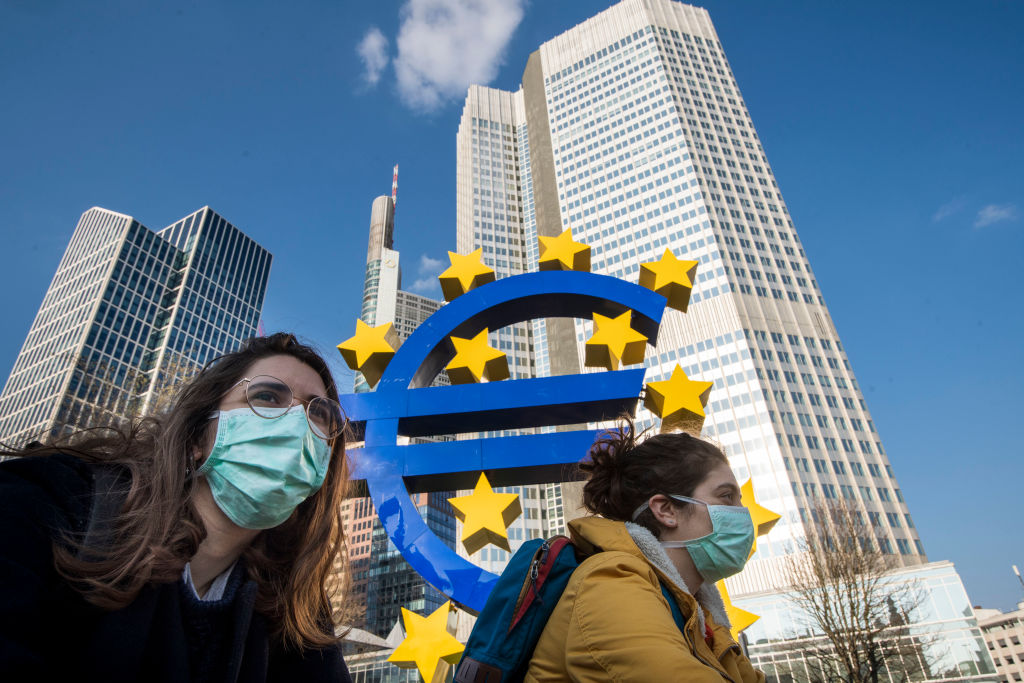
Two students wear face masks while they pass the Euro sculpture on bicycles in the finance district on March 19, 2020 in Frankfurt, Germany. Thomas Lohnes / Getty
After the 2008 crisis, governments were keen to insist that “we’re all in this together,” as the shockwaves of the financial collapse spread throughout the economy. Yet as it turned out, the measures taken in response proved to have a clear class logic. While states acted rapidly in order to prop up the banking sector, the resulting mountain of public debt was then used as a pretext for harsh austerity measures and neoliberal reforms of the labor market.
Today, faced with the coronavirus, we are seeing the damaging effects of that response. Even in countries with free public health care, the cuts of the last decade have left bed numbers and staffing levels much depleted. And as the European institutions discuss their response to today’s mounting economic crisis, there is again talk of “conditionalities” on states receiving help — meaning that today’s loans may translate to further austerity in the years to come.
Marc Botenga is a Member of the European Parliament for the Belgian Workers’ Party (PTB). Jacobin’s David Broder spoke to Botenga about the weakness of European solidarity, the opportunities the crisis offers in terms of reordering our economies, and the fight to make sure that any future vaccine is a free and public good.