Your Classes Are on Zoom and Your Teaching Staff Is Being Cut
Through decades of marketization, universities have replaced permanent teaching staff with temporary and often low-paid hires. Faced with COVID-19, they’re pulling the purse strings even tighter — as students pay high fees for online seminars with a shrinking band of overworked lecturers.
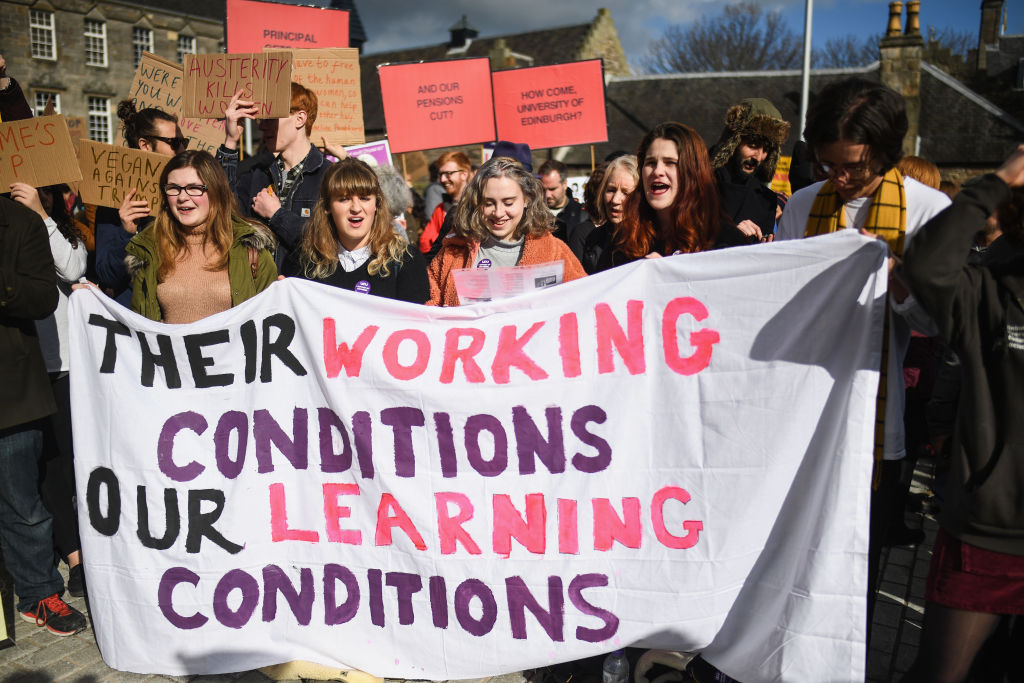
University workers attend a rally outside the Scottish Parliament on March 8, 2018 in Edinburgh, Scotland. Jeff J Mitchell / Getty
With the global COVID-19 pandemic still far from over, the neoliberal rhetoric of inevitable sacrifices is back — and stronger than ever. It comes hardly as a surprise, then, that the country where the Thatcherite slogan “There is no alternative” was coined seems to be at the forefront of a new round of austerity measures. Nowhere is this more evident than in the university sector.
For decades, academia in England has been a vanguard of the marketization of higher education — with the private sector and its for-profit logics entering campuses earlier here than in most other Western countries (the Scottish case is different in many respects). Changes in this direction started as early as the 1970s, but they became evident only in the following decades through a number of policies well documented by authors such as Stefan Collini, John Holmwood, and Andrew McGettigan: progressive reduction of public funding and growing reliance on the private sector, systemic casualization of the academic workforce, the assumption of the market as the organizing principle of higher education, and the introduction of quantitative and largely arbitrary auditing techniques.
This has also meant a change in the social role played by the university. Students are now conceived of as consumers buying a service, universities as firms competing with one another, and getting an education as the most typically neoliberal investment in human capital.