Forget McGovern — We Need to Stop the Democrats From Nominating Another Mondale
For decades, the Democratic establishment has been determined to avoid “another George McGovern.” They’ve been perfectly willing to risk another Walter Mondale.
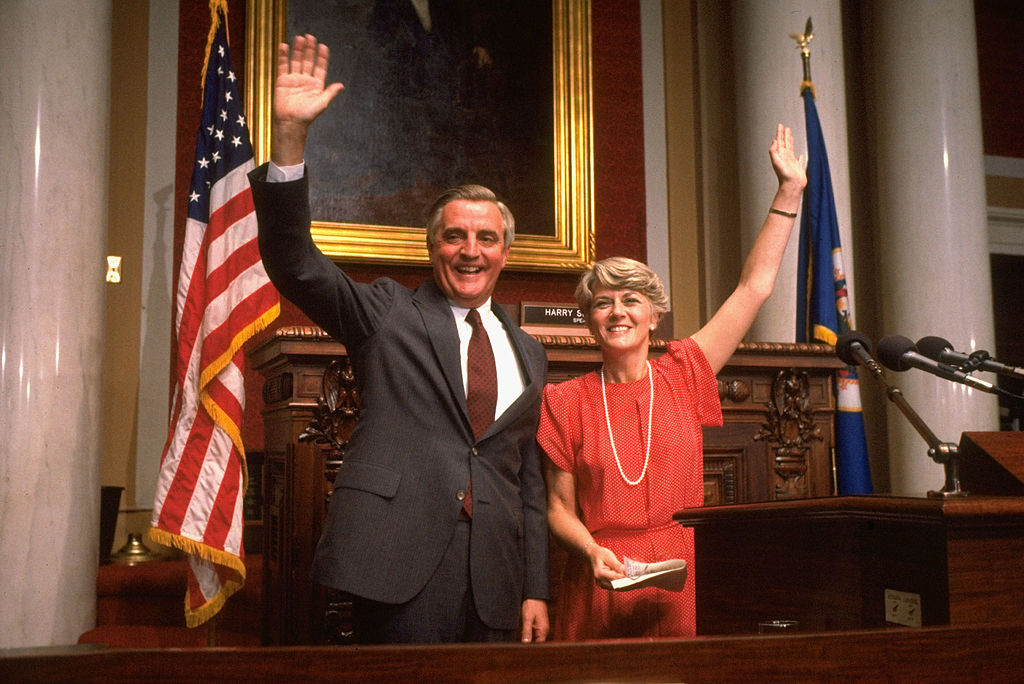
Dem. presidential candidate ex-vice president Walter Mondale introducing his running mate, Rep. Geraldine Ferraro, before the Democratic convention.Diana Walker / LIFE Images Collection via Getty
You can’t go far these days without hearing Bernie Sanders compared to George McGovern, the ill-starred progressive South Dakota senator who lost forty-nine states to Richard Nixon in a presidential election almost half a century ago. That defeat, the Atlantic reminded us recently, was “then the largest Republican landslide in U.S. history.” But that same article never mentions which election currently stands as the largest Republican landslide in US history: Ronald Reagan’s reelection in 1984. In fact, in the swell of discourse about the lessons of 1972, it’s hard to find any mention of Walter Mondale’s similarly monumental — and more recent — defeat. When the New York Times quotes Mondale in his capacity as a superdelegate, they mention his decades of experience but somehow avoid mentioning that he lost forty-nine states in the electoral college. It’s impossible to imagine the same newspaper mentioning McGovern without emphasizing his defeat.
The reason for this is not hard to understand — the Mondale experience yields opposite implications from the 1972 analogy, implications which are distinctly inconvenient for critics of Sanders.
In 1984, Democrats faced the unenviable challenge of running against an incumbent in the early stages of economic recovery. This much was similar to 1972. Nixon, declaring himself “now a Keynesian in economics,” pressed fiscal, monetary, and trade policy to their limits to drive the economy out of its post-Vietnam slump and into a manufacturing boom. Given our knowledge of the oil crisis and the years-long recession that followed, it is easy to forget how high animal spirits were in the lead-up to the 1973 War in the Middle East. It was no wonder McGovern lost in 1972, a year the US economy grew more than 6 percent — in fact, I have never seen a serious argument that a non-McGovern candidate could have won that year. A month after Nixon’s landslide, Business Week predicted: “Consumers, businessmen, and investors can plan with confidence — 1973 will be an excellent year for the economy. That is the clear consensus of the vast majority of economists, the economic consulting companies, and all of the widely known econometric models. Expectations of good business ahead are nearly unanimous.”