Today’s Social Democrats Should Be More Like Olof Palme
Swedish prime minister Olof Palme was assassinated on this day in 1986. He was an internationalist and the last social-democratic leader to really believe in a world beyond capitalism.
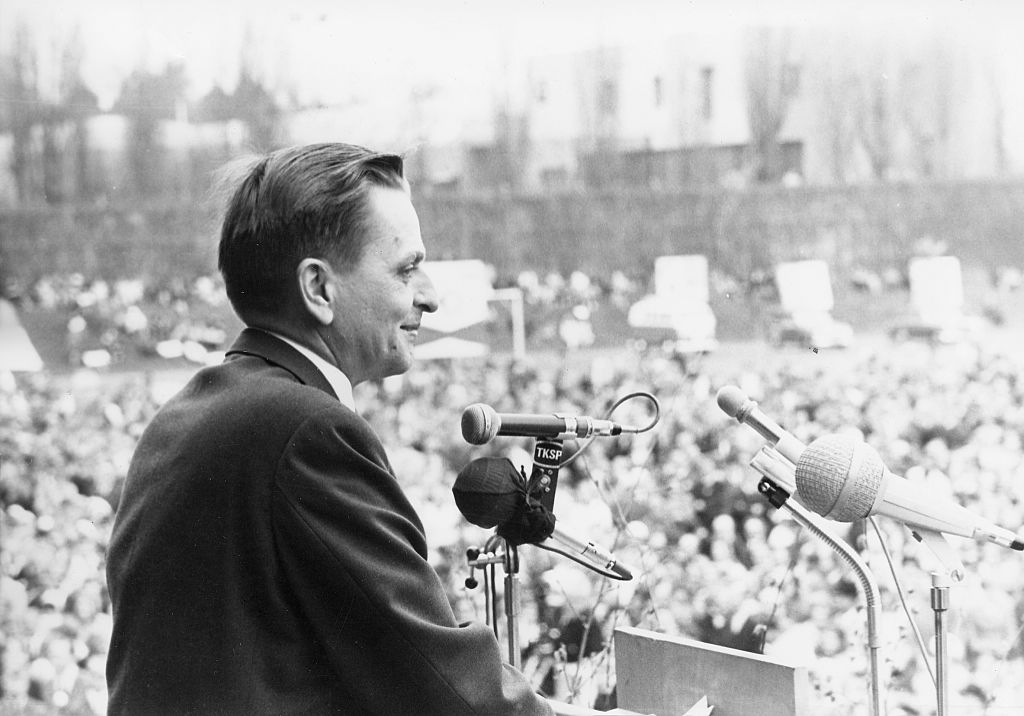
Olof Palme in front of microphones, in the background a crowd, 1969.Ullstein bild / Getty
At 11:21 PM on Friday, February 28, 1986, Swedish prime minister Olof Palme was murdered on the street in Stockholm. His murderer has not been identified and remains at large. At this time every year, Swedish newspapers and the mass media to speculate on new theories about who might have done it. But far too few reflect on his political impact.
Olof Palme was prime minister of Sweden for two stretches, from 1969 to 1976 and from 1982 until his death in 1986. During that time, he oversaw a Social Democratic Party that was still committed to a radically different vision of the world — and to challenging capitalism at home and imperialism abroad.
Palme is perhaps better known for the latter. Like Tony Benn, Olof Palme had come from an upper-class background and was a relatively moderate when he emerged onto the scene in the 1950s. And like Benn he was radicalized by the times, and in particular the anti-colonial and anti-war tumults of the 1960s. As Prime Minister, Palme’s internationalism was remarkable — supporting the Vietcong against the United States during the Vietnam War, condemning Franco’s regime in Spain as “goddamn murderers” for executing political prisoners and visiting Cuba in 1975, where he condemned the Batista regime and praised Cuba’s revolutionaries.