The Pressure Cooker in El Salvador
El Salvador president Nayib Bukele has been in office eight months, and his post-ideological pretenses on the campaign trail have quickly veered to the right. In an interview, Salvadoran economist Julia Evelin Martínez assesses Bukele’s first eight months in office, the sad state of the Salvadoran left, and why she’s fervently hoping for a Bernie Sanders presidency.
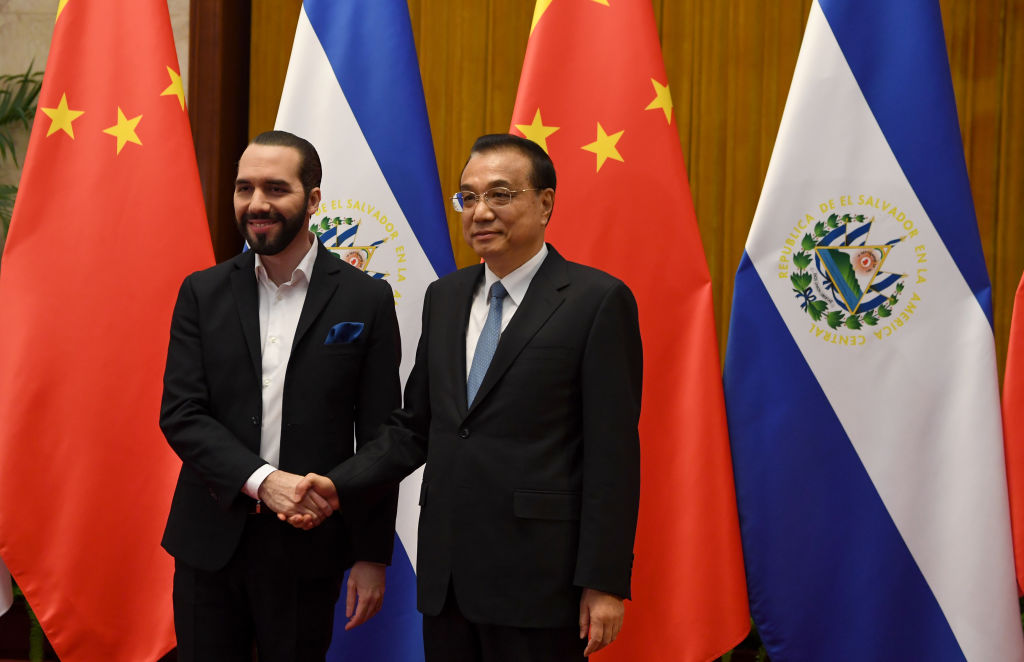
El Salvador president Nayib Bukele meets Chinese premier Li Keqiang at the Great Hall of the People on December 3, 2019 in Beijing, China. Noel Celis – Pool / Getty
On February 3, 2019, El Salvador elected insurgent candidate Nayib Bukele to the presidency, ousting the party of the former leftist insurgency, the Farabundo Martí National Liberation Front (FMLN), after two consecutive terms in office. Bukele, a millionaire millennial from a wealthy Palestinian family, positioned himself as an irreverent outsider against a corrupt and obsolete political class, claiming to transcend left-right divisions and overcome the deep partisan antagonisms that continue to structure Salvadoran politics decades after UN negotiations brought an end to a twelve-year civil war between the US-backed military dictatorship and the guerrillas. Despite his post-ideological pretenses on the campaign trail, Bukele’s administration has steered El Salvador sharply to the right.
Over ten years in power, the FMLN instituted major social programs, institutional reforms, and investment in El Salvador’s historically marginalized poor majority. But the former Marxist-Leninist insurgents failed to ameliorate the country’s deep-rooted crisis of gang violence and extortion, or to reform El Salvador’s profoundly unequal, US-dependent neoliberal economy. Mounting right-wing destabilization together with the regional rightward turn left the FMLN increasingly isolated internationally and debilitated internally.
Bukele, never an FMLN cadre, was drafted to run as an FMLN mayor in 2012 through the influence of his late father, a major party donor. The young advertising executive brought refreshing vigor to a party still led by aging former comandantes, but his ambitions and insubordination to party discipline culminated in expulsion in 2017. After failing to establish his own “New Ideas” party in time for the 2019 elections, Bukele sought the presidency with the conservative GANA (Grand Alliance for National Unity) party and won a sweeping victory.