We Need a Media System That Serves People’s Needs, Not Corporations’
Our corporate media system prioritizes making money over producing adversarial journalism and covering working-class issues. We should dare to imagine something different: a public media system that privileges democracy over profits.
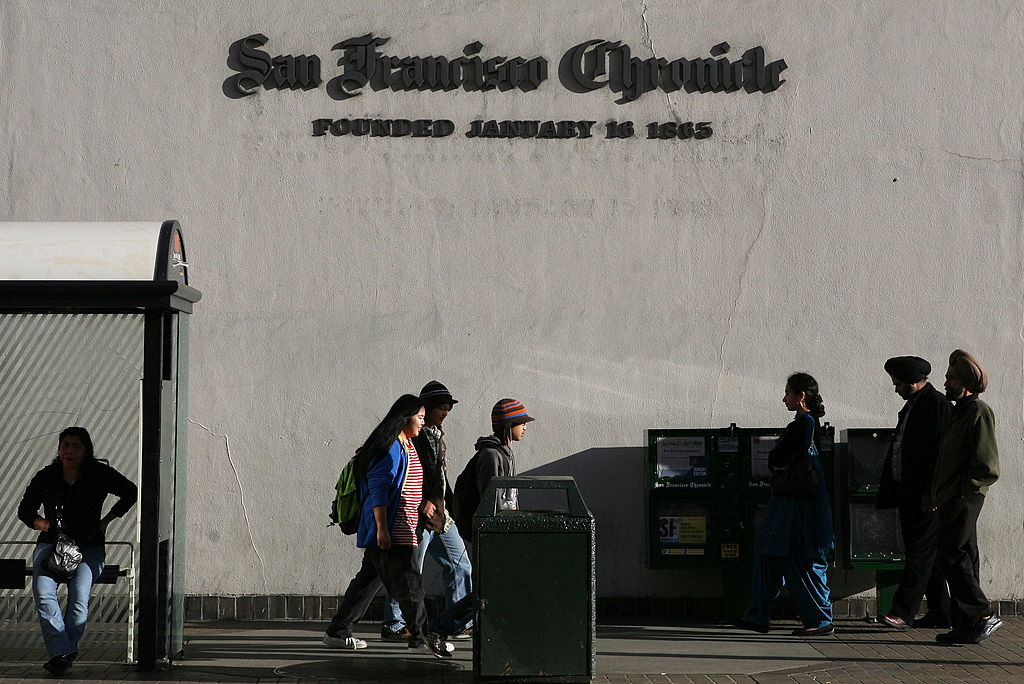
Pedestrians walk by the San Francisco Chronicle building on February 24, 2009 in San Francisco, CA. (Justin Sullivan / Getty Images)
The past decade has witnessed the rapid decline of the newspaper industry in the United States. Revenue and readership have dropped precipitously, halving the nation’s newspaper employees. Actual journalism is vanishing, misinformation is proliferating, and our public media system — ideally a safety net for when the market fails to support the press — remains utterly impoverished compared to its global counterparts. From the collapse of its advertising-dependent business model to the dominance of platform monopolies like Facebook and Google, the commercial news media system faces a structural crisis.
Commercial journalism never fulfilled all of society’s democratic needs, but now it’s abundantly clear that the market can’t support the bare minimum levels of news media — especially local, international, and investigative reporting — that democracy requires. Any path toward reinventing journalism must acknowledge that the market is its destructor, not savior. Commercialism lies at the heart of this crisis; removing it could be transformative.
If we acknowledge that no entrepreneurial solution lies just around the bend — if we stop grasping for a technological fix or a market panacea — we can look more aggressively for non-market alternatives. In doing so, we can dare to imagine a new public media system for the digital age, one that privileges democracy over profits. A journalism that seeks out silences in society and ruthlessly confronts those in power. An information system that maintains laser-like focus on climate change, hyper-inequality, mass incarceration, and other social emergencies. A media system that treats workers as more than an afterthought.