Liberals Should Stop Wringing Their Hands Over Voting Labour
There are only two real choices in the UK election — Jeremy Corbyn’s Labour and Boris Johnson’s Tories. Comfortable liberals who claim to be “politically homeless” are exposing their cluelessness about the misery and havoc another Tory government will impose on ordinary Britons.
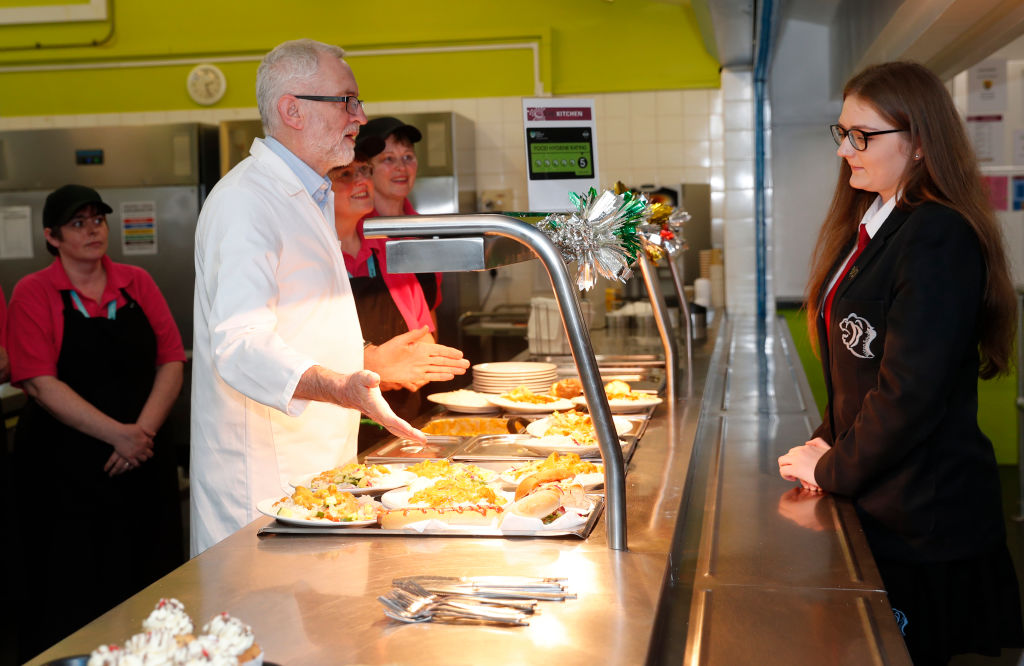
Labour Party leader Jeremy Corbyn serves lunch to a pupil during a visit to Bilton High School on December 05, 2019 in Rugby, England. Darren Staples / Getty Images
The latest centrist trend in the British commentariat is to claim to be “politically homeless.” The concept rests on the fact that they would rarely vote Conservative but dare not vote for Jeremy Corbyn’s Labour Party, and all energy is spent attacking Labour. The “politically homeless” should have been served by Change UK/The Independent Group, but the whole endeavor collapsed. Westminster journalists were utterly convinced that a huge untapped centrist demographic sat waiting to be rescued by such a team. But alas, they disintegrated, and most members of Parliament (MPs) quit the group, with only three standing in this election, two of them using Labour colors on their posters, presumably to trick the electorate.
There’s a certain overprivileged indulgence in histrionically throwing around the phrase “politically homeless.” It’s impossible to walk down any main street in London without encountering homeless people. This is a new problem. Since the Conservatives came into power, street homelessness has risen by 165 percent. Near the Houses of Parliament, homeless people have put up tents to keep themselves warmer at night. In the subway that leads into Parliament, dozens of homeless people sleep away from the rain. Every train and Tube station in London has multiple beggars outside, while the London Underground regularly plays a robotic announcement asking people not to give to homeless people begging in the carriages. In London, one in fifty-two people have no home; less public are the 320,000 people that homelessness charity Shelter estimates to fall into the category it calls “hidden homeless,” those in temporary accommodations or sofa-surfing. But Shelter warns this is a gross underestimate: it’s almost impossible to find out the sheer scale of the problem.
By contrast, those who describe themselves as politically homeless are all from a very specific demographic. They are usually people in middle age who believed New Labour to be the height of utopian political policy. They own their own home and will never be at risk of homelessness. They are utterly convinced voters are exclusively concerned with Brexit and define themselves as Remain or Leave, largely because their friends do so. Their politics is based entirely on the fact that they correspond exclusively with a small group of friends who also graduated from Oxford, and they fetishize the 2012 Olympics, believing Britain was a utopia then.