Lula Comes Home
Lula’s release will not change the course of Brazilian politics by itself. But the leftist leader has already said his time in prison further radicalized him — and that can only bode well for the popular movement resisting Bolsonaro’s reactionary politics.
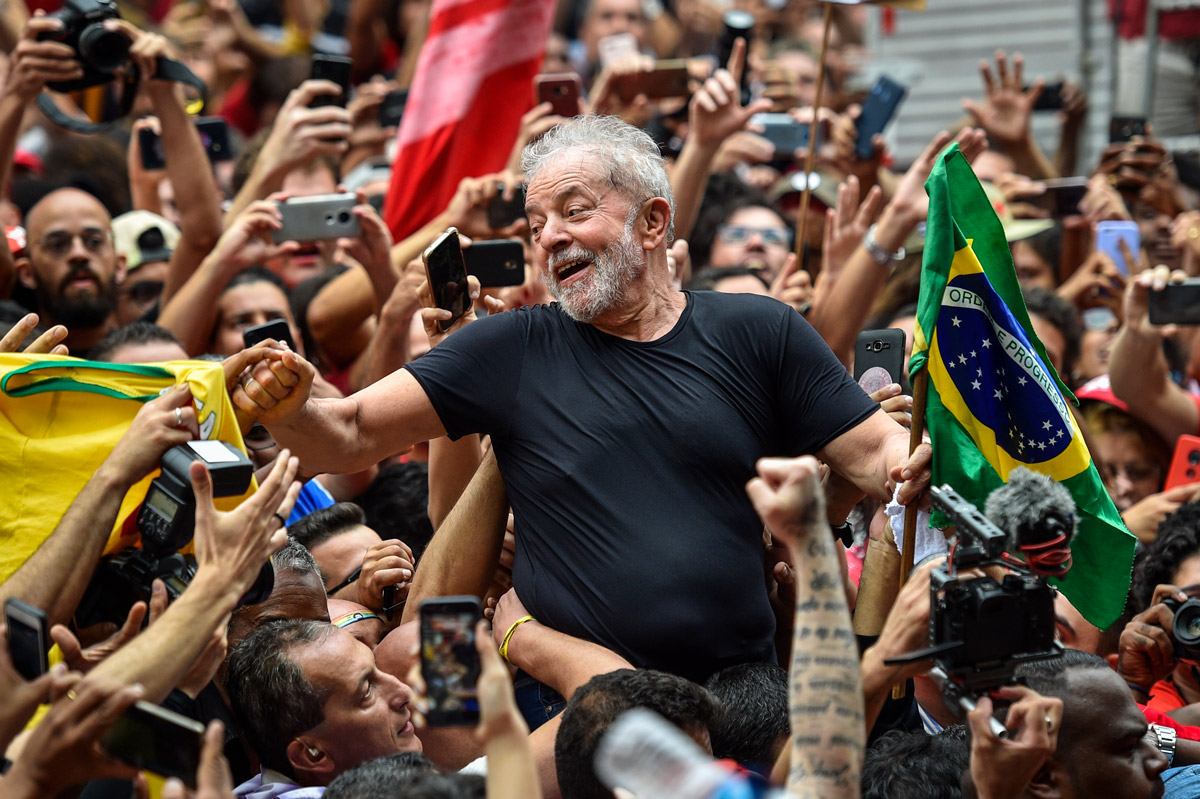
Lula da Silva, Brazil’s former president, greets supporters on November 9, 2019 following his release from prison in São Bernardo do Campo, Brazil. (Pedro Vilela / Getty Images)
On Thursday, Brazil’s Supreme Court handed down a decision of enormous consequence, finding that defendants cannot be incarcerated before every possible appeal has been heard and adjudicated. This procedure is explicitly spelled out in Brazil’s progressive constitution, ratified in 1988 after twenty-one years of military rule, and had been legal commonplace for about three decades.
But something changed in Brazil in recent years as a virulent anti-corruption drive ensnared the nation. The moralistic frenzy toppled a sitting president and implicated her party — along with the center-right opposition — in vast corruption schemes. It also empowered radical right-wing forces for whom democracy itself was suspect, culminating in the election last year of proto-fascist Jair Bolsonaro, who ran as an outsider despite serving in Congress for over a quarter-century.
A purported effort to root out corruption resulted in ad hoc legalistic rationalizations that ignored the text of the constitution almost completely. In the name of locking up powerful and well-connected elites that critics note (not unreasonably) game the system to indefinitely skirt accountability, the moralizing prosecutors and judges of Operation Car Wash, a sprawling investigation into corruption at state oil company Petrobras, successfully argued that the constitution was an obstacle to be worked around. No doubt influenced by the deification of Operation Car Wash in the domestic and international press, and tacit threats from the armed forces, Brazil’s highest court facilitated the crusade against corruption in 2016 by sanctioning arrests after only one appeal. This paved the way for the imprisonment of former Workers’ Party (PT) president Luiz Inácio Lula da Silva on what prosecutors even privately admitted were flimsy charges.