When German Unions Built Housing for the People
In postwar Germany, a cooperative run by trade unionists created Europe’s largest housing company. Building over 400,000 homes, “Neue Heimat” showed we don’t have to live on the terms dictated by landlords — we can take control for ourselves.
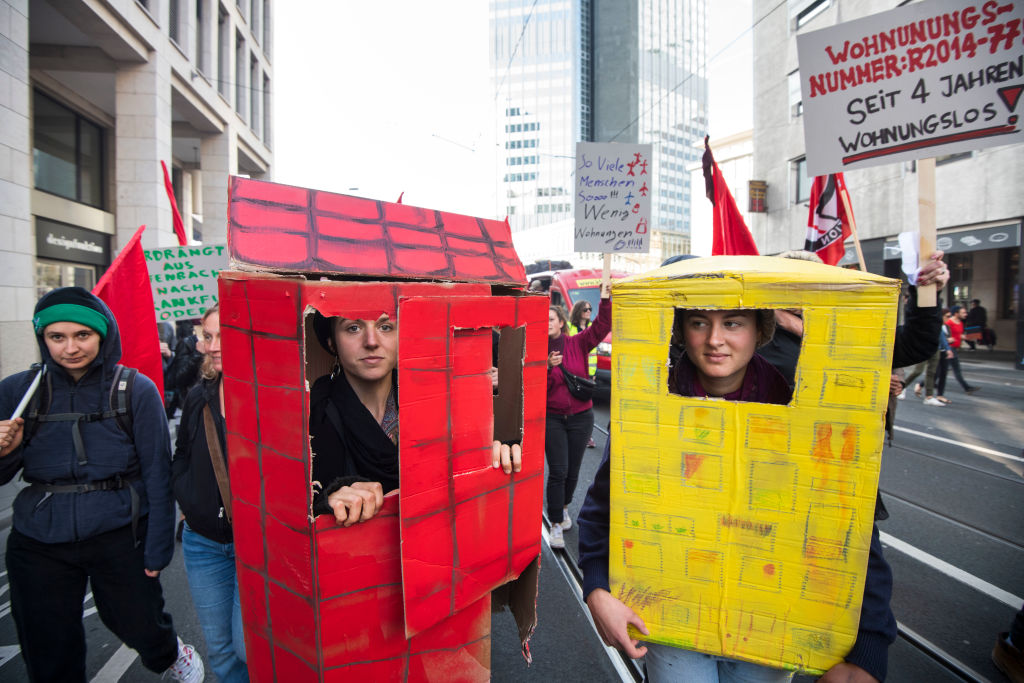
Protesters demonstrate against rising housing rental prices on October 20, 2018 in Frankfurt, Germany.Thomas Lohnes / Getty
In recent months, Germany’s “rent crisis” has captured international attention. This particularly owes to a headline-grabbing initiative in Berlin, where faced with the rising rents, activists are working to force a referendum on the expropriation of the biggest landlords. Even beyond the capital, continual rent hikes and a series of massive demonstrations have urgently posed the need for practical solutions to the housing problem. Yet if today renters are struggling to pay their bills, they didn’t always find themselves in such a bind. For there was a time when Germany was home to one of the West’s most ambitious social housing projects — and it was run by trade unionists.
This was, indeed, no small initiative. Until 1982, the German Trade Union Confederation — the Deutsch Gewekschaftsbund (DGB) — owned the largest housing and construction companies in Europe. Encompassing 400,000 apartments, its portfolio also included swimming pools, shopping malls, office spaces, universities, congress centers and health clinics. It was one of the world’s most significant examples of a cooperative social housing project — one built not in the interests of corporate profit, but from below, in service of residents themselves.
At its peak, the DGB’s Neue Heimat (“New Homeland”) had a turnover of 6.4 billion DM (around €3 billion in today’s money) and employed nearly 6,000 people, with dozens of subsidiary companies throughout West Germany and the world. The idea was to create affordable cooperative housing, democratically owned and managed by the broad sections of the population who lived in them.