Trump’s New SNAP Rules Will Cause a National Public Health Crisis
The Trump administration is about to remove 3.5 million people from food stamps entirely. The consequence will be a massive health crisis for working-class people.
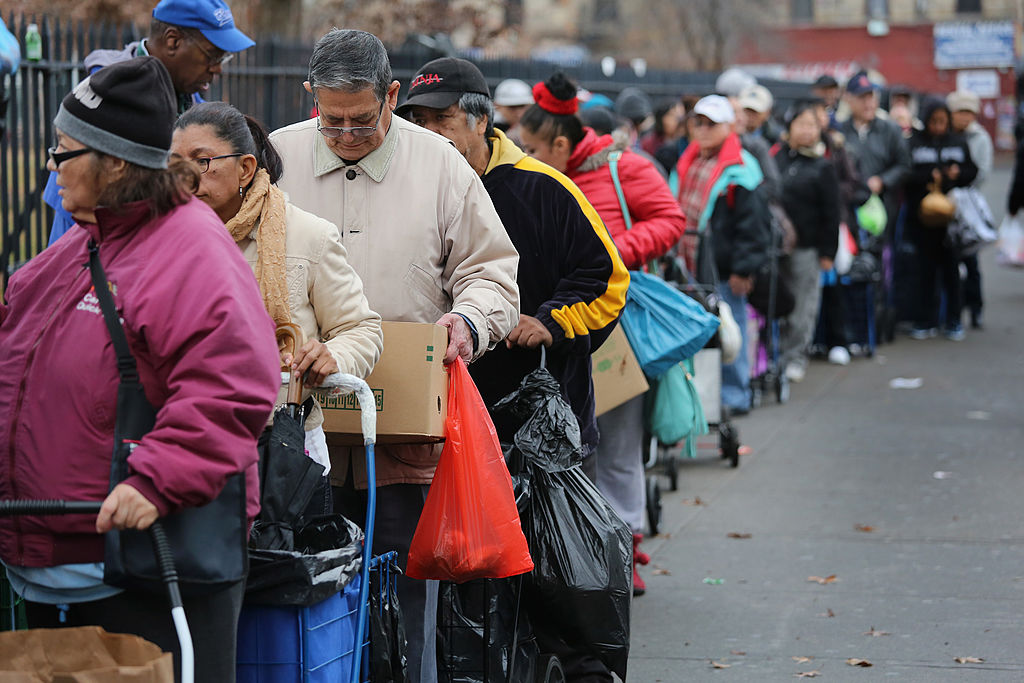
Residents receive free food as part of a Bowery Mission outreach program on December 5, 2013 in Brooklyn, NY. The Christan ministry says it has seen a spike in need since food stamps to low-income families were reduced in November with cuts to the federal Supplemental Nutrition Assistance Program (SNAP). (John Moore / Getty Images)
The Trump administration’s continued war on welfare directly targets a system that today provides crucial, if fragmented, state support for the working class in the United States. Its latest mark is the Supplemental Nutrition Assistance Program (SNAP, colloquially known as food stamps). SNAP, along with other programs, effectively holds crisis at bay for many working-class families, serving the immediate needs of some of the poorest Americans through an average monthly benefit of $127 to over 40 million people. On July 24, 2019, the USDA Food and Nutrition Service (USDA-FNS) proposed a rule that would remove 3.5 million people from food stamps entirely. In the pursuit of a multiracial, working-class movement, we must defend the health of low-income people, while opposing the erosion of essential benefits and continued use of means-testing for basic services.
The federal government already uses aggressive means-testing to determine who qualifies for SNAP. Under the new rule, that would only worsen: those with an income above 130 percent of the federal poverty line or in possession of more than $2,250 in assets would be excluded. The limit rises to $3500 for households with an elderly or disabled person. The rule would eliminate the moderate flexibility states currently have in deciding who is SNAP-eligible in each state’s specific context.
As it is, SNAP leaves substantial gaps in coverage, and its beneficiaries routinely face food shortages and rationing toward the end of the month when their allotment runs low. This can have catastrophic effects on their health. While working on a research study, one of the authors of this article met a participant who periodically stopped taking her HIV medication when she ran out of food, because the drug was meant to be taken at mealtimes. The virus made a resurgence in her blood and became resistant to this medication. She developed a dangerous form of inflammation in her brain and started experiencing a complex of symptoms known as HIV-associated neurocognitive disorder. This rule change will only exacerbate existing gaps in state support, making cases like this patient’s all the more likely to affect lower-income people.