East Germans Still Feel Powerless
- Sam Langer
- Joel Scott
Almost thirty years since reunification, the Alternative für Deutschland is making its strongest gains in the former East. But the far right’s growth doesn’t just owe to Eastern xenophobia — it owes to millions of people’s sense of being mere second-class citizens.
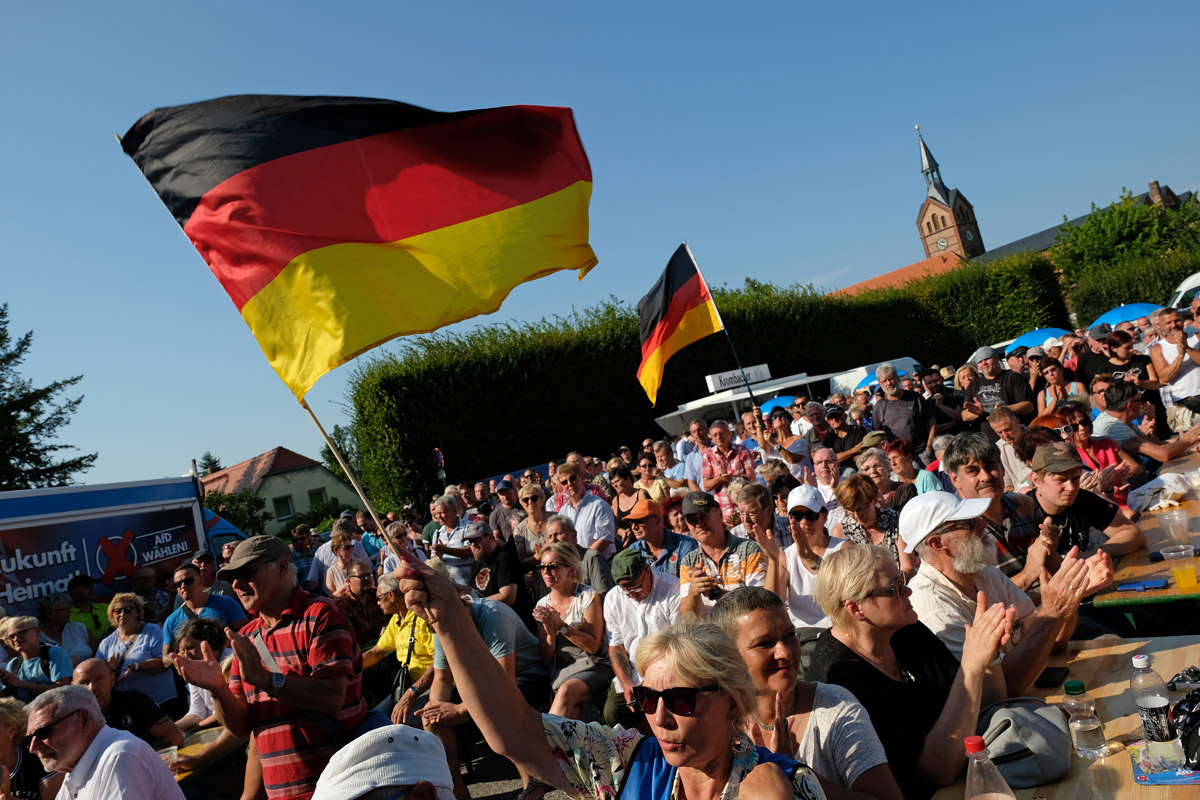
Supporters of the right-wing Alternative für Deutschland (AfD) political party wave German flags as they listen to AfD speakers campaigning for the Brandenburg state elections, on August 25, 2019 in Peitz, Germany. (Sean Gallup / Getty Images)
East Germany is in the news again. The reasons are rather bleak: the National Socialist Underground and the Islamophobic Pegida have become household names, and now the far-right Alternative für Deutschland (AfD) is going from one electoral success to the next. Thirty years after the democratic awakening in the German Democratic Republic (GDR), the accusation goes, many Easterners have yet to find their place in reunified Germany, and neither government cash nor grand speeches seem to help.
Public opinion may be divided about the root causes, but the ongoing and even solidifying divide between East and West in opinions, habits, and political attitudes can’t be denied. Writing in the Neue Zürcher Zeitung Daniel Dettling recently summed up the kind of irritation widespread among Western commentators when he counterposed Easterners’ rising living standards — improving faster than in the West, with a sharper fall in unemployment — to a more pervasive “sense of powerlessness” and “political populism that feeds off this powerlessness.”
Much data, in fact, paints a less optimistic picture than Dettling suggests — in recent years growth has slowed or even come to a standstill. Nevertheless, it is true that apartments, houses, and cities in the former East have been modernized and infrastructure upgraded or newly built; many businesses utilize state-of-the-art technology in their production processes and are able to compete in the world market.