Labor Has Only One Candidate: Bernie Sanders
At the Philadelphia Workers’ Presidential Summit, Joe Biden disappointed while Elizabeth Warren didn’t even bother to show. Only Bernie Sanders has the plan and the record to help bring the labor movement back.
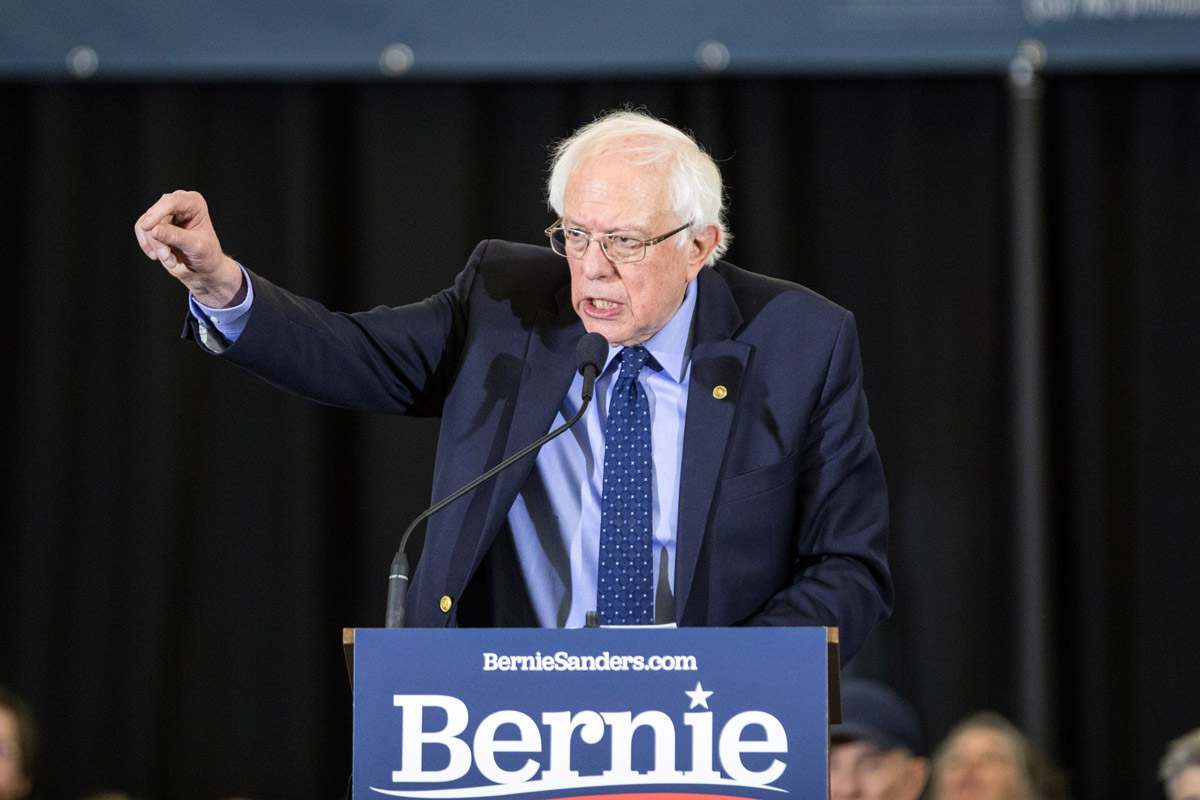
Bernie Sanders speaks during a campaign event on March 10, 2019 in Concord, New Hampshire. (Scott Eisen / Getty Images)
On September 17, the Philadelphia AFL-CIO hosted its first-ever Workers’ Presidential Summit, a forum where those vying for the Democratic Party’s nomination addressed the hopes and concerns of the city’s rank-and-file union members. It would be difficult to choose a more appropriate place than Philadelphia to discuss the existential threats facing the labor movement. Despite being a city where unions remain a political heavyweight, Philadelphia workers have endured their share of the attacks as nurses and hospital staff, refinery workers, public school teachers, academics, those in the building trades, and others have faced closures and unsafe, undercompensated working conditions. Pennsylvania, too, continues to be a likely battleground state in the upcoming 2020 general election, one which could fall into the hands of Donald Trump once again. Three years ago, Hillary Clinton received an astounding twenty thousand fewer votes in Pennsylvania than Barack Obama’s 2012 campaign won in Philadelphia alone. Those lost votes made up nearly nearly half the margin of which she lost the state to Trump. If once-reliable union strongholds like Philadelphia are unable — or, in some instances, perhaps unwilling — to deliver their votes to a Democratic Party that has largely turned its back on labor, it could happen again.
Given these stakes, why was Senator Bernie Sanders the only Democratic front-runner to accept the invitation to the summit when it was first announced weeks ago? Shockingly, Joe Biden — who has made his political career feigning working-class — only agreed to the event at the last hour, following a two-week saga of Philadelphia labor leaders publicly lamenting the candidate’s previous unwillingness to attend. Recently surging Elizabeth Warren, darling of a particular strata of more affluent liberal progressives, remained firm in her decision to snub the event. It speaks volumes about Sanders’s commitment to building labor power — and his sheer electability — that he stood alone among the serious contenders for the office in enthusiastically accepting the call to meet with and learn from Philadelphia’s working class.
Of Faux Working-Class Candidates and Technocrats
Biden’s and Warren’s attitudes toward the summit make clear that their candidacies stand very little chance at reinvigorating the kind of worker power that will carry us not only through the 2020 elections, but beyond into a new age of labor movement ascendency. Upon learning that Biden had decided to stand them up, Philadelphia labor and Democratic Party leaders expressed dismay over the former vice president’s failure to live up to his working-class affect. There was some reason to believe that Biden would leap at the opportunity to appear before Philadelphia workers. In April, Biden held his first campaign rally with Teamsters Local 249 in Pittsburgh, Pennsylvania where he boasted about being a “union man” and brandished his moniker, “Middle-Class Joe.” There, he growled about overpaid CEOs “squeezing the life out of workers” and championed labor reforms that would give union members a much-needed leg up at the bargaining table. And at the summit this week, one could be forgiven for mistaking Biden for a class-struggle candidate when he told union members that they are “the only ones who keep the barbarians on the other side of the gates.”