A Red Deal
The Green New Deal can connect every struggle to climate change. A Red Deal can build on those connections, tying Indigenous liberation to the fight to save the planet.
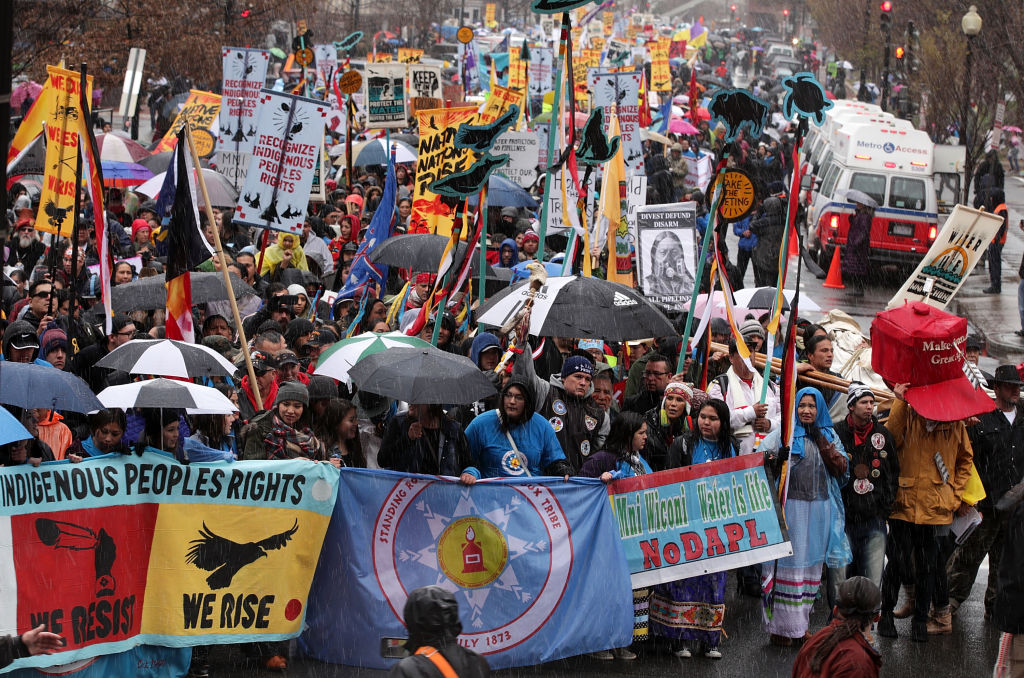
Activists participate in a protest against the Dakota Access Pipeline March 10, 2017 in Washington, DC. Alex Wong / Getty Images
2016 was the hottest year on record — so far. It also marked historic Indigenous-led protests against the Dakota Access Pipeline at Standing Rock.
But Indigenous resistance didn’t begin or end there. What did begin there was Alexandria Ocasio-Cortez’s successful bid for Congress, and an Indigenous-led movement that galvanized the popular forces behind the Green New Deal, legislation that she introduced with Senator Ed Markey earlier this year. Ocasio-Cortez is herself a Water Protector, having visited the prayer camps, and Standing Rock was part of a recent constellation of Indigenous uprisings across North America and the US-occupied Pacific: Unist’ot’en Camp (2010), Keystone XL (2011), Idle No More (2012), Trans Mountain (2013), Enbridge Line 3 (2014), Save Oak Flat (2015), Protect Mauna Kea (2015), Nihígaal Bee Iiná (2015), and Bayou Bridge (2017), among many others.
Each movement rises against colonial and corporate extractive projects. But what’s often downplayed is the revolutionary potency of what Indigenous resistance stands for: caretaking and creating just relations between human and nonhuman worlds on a planet thoroughly devastated by capitalism.