Salvini Can Be Beaten
Far-right leader Matteo Salvini brought down the Italian government because he wanted fresh elections. A pact among the other parties could stop his advance — but only if it breaks with austerity.
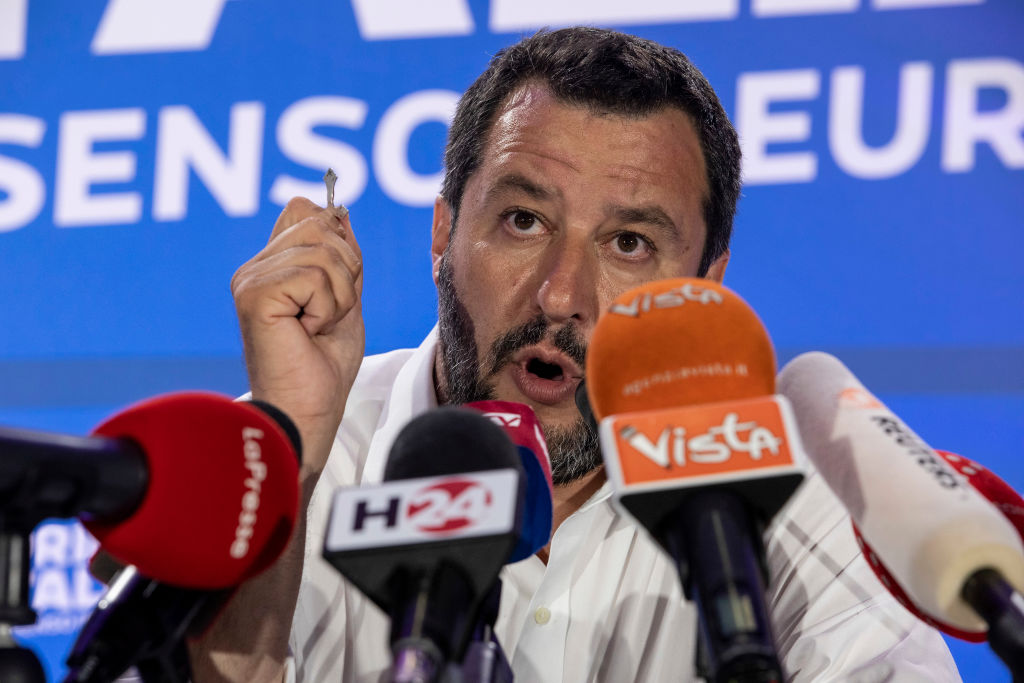
Italy’s deputy prime minister and leader of right-wing Lega (League) political party Matteo Salvini holds a crucifix in his hand while attending a news conference following the European Parliamentary election results at Lega’s headquarter on May 27, 2019 in Milan, Italy. (Emanuele Cremaschi / Getty Images)
It seems Matteo Salvini isn’t so invincible after all. On August 8, he seemed to have seized the political initiative once more, as he announced that he was withdrawing support from Giuseppe Conte’s government. Since forming a pact with the eclectic Five Star Movement (M5S) in June 2018, Salvini has not only dominated the headlines but steadily risen in the polls, from 17 percent in last March’s general election to 34 percent in this May’s European contest. Exploding Conte’s M5S-Lega-backed government, Salvini sought to force the early general election that would hand him what he called “full powers.”
Yet this plan soon faced pushback. Above all, Salvini had underestimated the other parties’ determination to block such a vote. The tone was set on August 10, when the M5S founder Beppe Grillo published a blog post whose title invoked “The Consistency of the Cockroach” — the spirit of self-preservation. M5S has fallen from 32 to 17 percent in the polls over the last year, and Grillo called for the formation of a new government to “stop the barbarians,” rather than the early election that would bring electoral wipeout. In this cause, his party has found surprising allies in their long-sharpest enemy: the center-left Democrats (PD).
The prospect of a pact between these parties has blown a hole in Salvini’s call for early elections. Although his call for no-confidence motion has, indirectly, forced the resignation of prime minister Giuseppe Conte (independent leader of the M5S-Lega pact), this came only after over a week’s delay, indeed imposed thanks to a PD alliance with M5S. This has bought time for legislators to plan alternative governments, able to replace the current M5S-Lega tie-up and avoid the need for early elections. Such an arrangement would most likely draw Nicola Zingaretti’s PD and other small center-left forces into some sort of pact with Luigi Di Maio’s M5S.