Who Calls the Shots
Italy’s far-right Matteo Salvini faces charges for the kidnapping of 177 migrants. But the supposedly anti-establishment Five Star Movement can block the trial — and probably will.
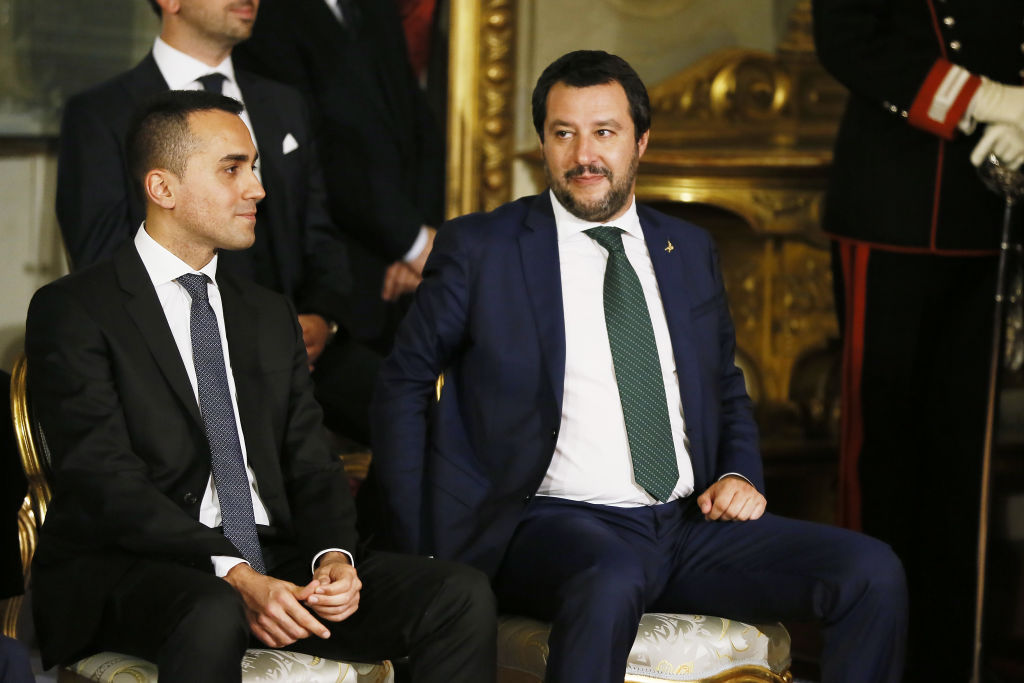
Luigi Di Maio and Matteo Salvini attend the swearing in ceremony of the new government led by Prime Minister Giuseppe Conte at Palazzo del Quirinale on June 1, 2018 in Rome, Italy. Ernesto S. Ruscio / Getty Images
If this author’s dispatches from Rome can be taken as an ongoing journal of Italian politics, readers will note that the pessimistic predictions were the ones that actually played out. This is especially expressed in the rise of Matteo Salvini’s Lega, a force that won 4.1 percent in the 2013 general election but is now polling over eight times that (33.8 percent). Today the main force on the (radicalizing) right, it dominates the political agenda; its government partner, Luigi di Maio’s Five Star Movement (M5s), scored double the Lega’s vote in the March 2018 general election but now lags ten points behind it in the polls (24 percent).
The government’s already precarious balance is particularly threatened by May’s European elections, in which Salvini’s party will surely win a national contest for the first time. If in some countries the ballot for the Brussels parliament brings low turnouts and large protest votes, in Italy it is taken seriously; after the last contest five years ago, new Democratic Party premier Matteo Renzi took his party’s 40 percent as a mandate for domestic reforms. And breakthrough for the Lega this time around could push Italy toward fresh elections, if Vice Premier Salvini bids to capitalize on his advantage as leader of the Right.
Fearing the losses it would suffer in such a contest, the eclectic M5s has kowtowed to the hard-right Salvini. Lacking roots in historic left or right and claiming to stand for “citizens” rather than “politics,” its spell in office with the Lega has brought its most reactionary elements to the fore. Beyond bad polling news for Di Maio’s party (down eight points since its success in the March 2018 election), a series of flashpoints testing relations between the two parties have shown M5s to be the victim of its own short-termist opportunism, abandoning policy after policy to maintain ties with the Lega.