“Socialism From Above” and the Capitulation to Fascism
In 1930s Europe, Hendrik de Man’s bid to replace class struggle with state planning led to a deadly embrace with fascism. His attempt to graft nationalism onto socialism offers a terrible lesson for social democrats today who adapt their politics to far-right ideas.
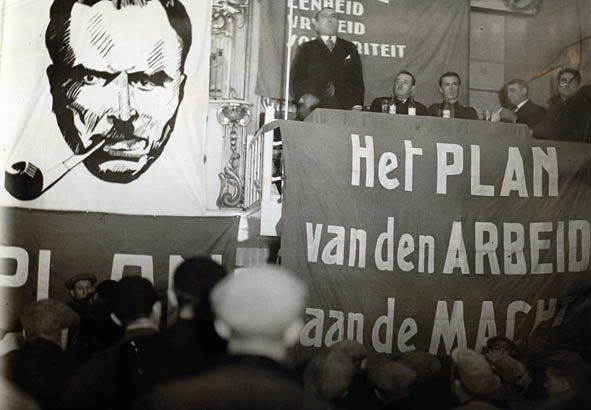
A meeting for the Plan of Labor circa 1930s. On the left, an image of Hendrik de Man with a pipe and the inscription: “The Plan of Labor to Power.” (AMSAB-ISG)
Hendrik de Man didn’t fight back against the Nazi takeover. Dissolving the once-formidable Belgian Workers’ Party (BWP) as German troops invaded his country in June 1940, he instead advocated collaboration with Europe’s new overlords. Rather than “resist” Nazi Germany, the Belgian socialist told his comrades that they should “accept the fact of its victory and try to draw lessons from it in order to initiate a new form of social progress.” He insisted that “far from being a catastrophe this collapse of a decayed world represents liberation for the working classes and for socialism . . . ”
These words had a particularly powerful effect because in his day de Man was among Europe’s most famous and influential socialist thinkers. He was most notable for his “Plan of Labor” — or “Plan de Man” — which advocated far-reaching state planning and intervention within existing capitalist frameworks. Its proposals for public works and the nationalization of credit and monopoly industries — popular among social-democratic militants looking for immediate, concrete alternatives — developed in parallel and sometimes in dialogue with emerging Keynesian economics and the New Deal policies in the United States.
As a political movement “planism” became popular in the 1930s not only among Belgian workers, but also among “neo-socialists” across Europe. Similar Plans of Labor were drafted in the Netherlands and in Switzerland, and in France the right-wing of the Socialist French Section of the Workers’ International (SFIO) was also attracted to de Man’s planism. Led by Marcel Déat, René Belin, and Pierre Renaudel, the French neo-socialists argued that the rise of fascism showed the urgent need to introduce state-planned capitalism as opposed to the traditional strategies of gradual reformism or waiting for the revolution to come.