“Ulysses” Truthers Are the Latest Threat to Corbyn
Jeremy Corbyn recently mentioned that he’d read James Joyce’s Ulysses and liked it. It triggered a deranged uproar from Britain’s elite cultural gatekeepers. They’re just mad we’re coming for their stuff.
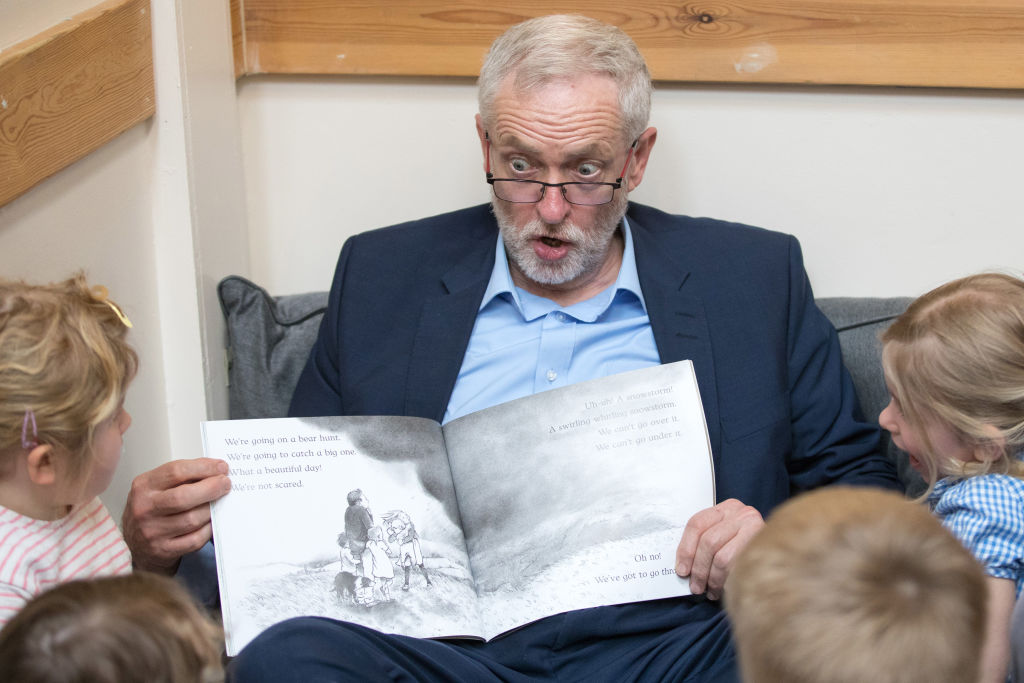
Jeremy Corbyn reads the book We’re Going on a Bear Hunt to children at a visit to Brentry Children’s Centre in Bristol, England. (Matt Cardy / Getty)
Centrism is a nightmare from which I am trying to awake. Jeremy Corbyn’s election as Labour leader almost four years ago has made a sizable portion of the center-ground commentariat and a horde of online pundits rabid with fury, with certain tropes that veer toward conspiracy theory endlessly returning, more deranged with each coming.
One persistent myth began when Corbyn was asked, in an online forum for middle-class mothers, what his favorite book was, and he replied, “Ulysses, on the grounds that it’s very hard to understand the first time and doesn’t get much easier on the third or fourth reading of it.” It wasn’t the most obvious choice: a more cynical politician might have prepared an answer to make political capital — perhaps choosing The Ragged-Trousered Philanthropists, in a nod to a pivotal scene in the eerily familiar A Very British Coup, with its Tony Benn–style leader, Harry Perkins, now embodied by Corbyn.
But no matter: plumping for James Joyce’s Ulysses led to surging histrionics from Corbynsceptics and the Right. In time for Bloomsday this year, the Guardian released an interview with Corbyn on Joyce and Ulysses, predictably enticing yet another centrist meltdown. Corbyn was lying; he hadn’t read Ulysses, and was only saying so to appear intelligent. And if he had read it, he hadn’t fully understood it. Literary texts have only one monolithic reading, as any fool knows, and Joyce’s thickest text is simply a puzzle to be solved and read through one lens, rather than as a dense psychological text, a postcolonial meditation, a musing on Irish nationalism, or a deep-cover guerrilla marketing campaign by the Dublin tourist board.