The Grotesque Horror Show of the Tory Leadership Race
The Tory leadership race has got everything: a media class besotted with their latest centrist savior, a kamikaze Conservative Party in full self-immolation mode, and a Labour Party leadership under siege from enraged Remainer ultras. Coming soon: Boris Johnson in 10 Downing Street.
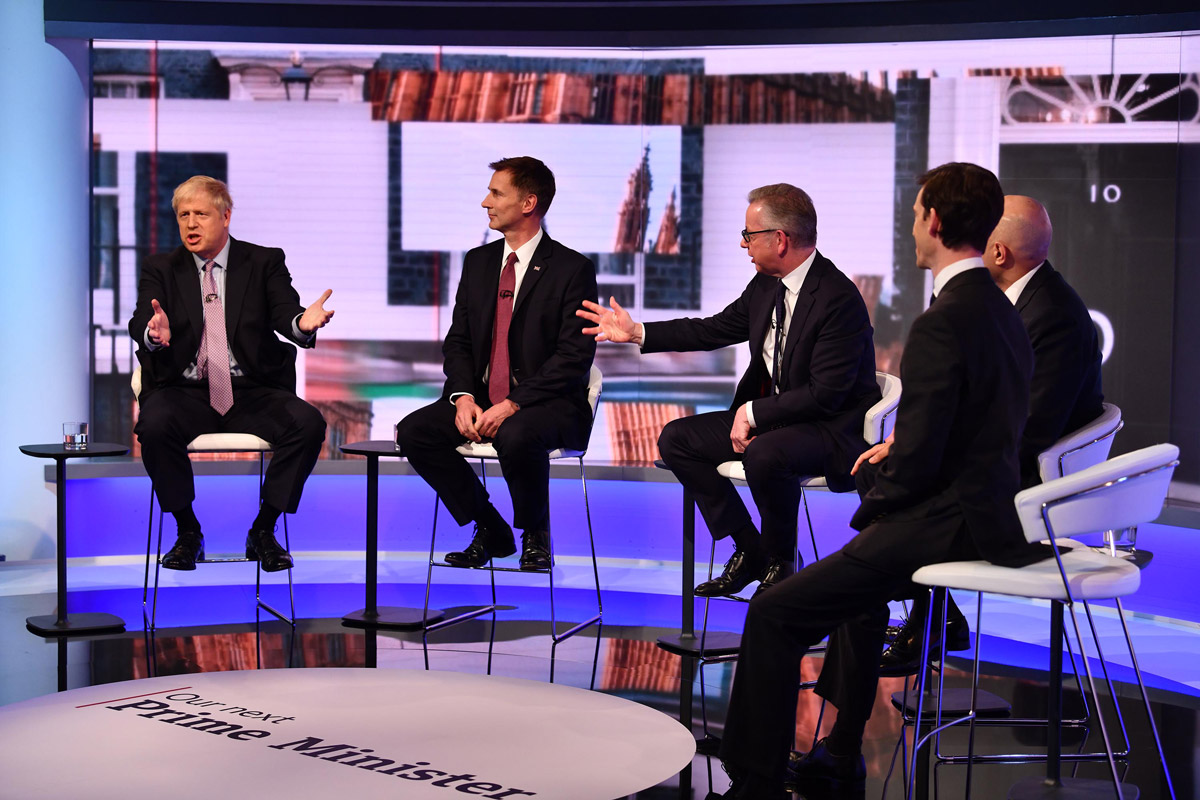
Boris Johnson, Jeremy Hunt, Michael Gove, Rory Stewart, and Sajid Javid participate in a Conservative Leadership televised debate on June 18, 2019 in London, England (Jeff Overs / Getty Images).
On Thursday, Conservative MPs whittled down the candidates for the next Tory leader to two finalists: Boris Johnson (the current favorite) and foreign secretary, Jeremy Hunt. Although the next prime minister is being chosen by a bizarrely small selectorate, most of us cannot opt out of the media charade, nor vote on whether we will continue to be ruled by the party that is subjecting us to the race, thanks to the Fixed Term Parliaments Act stipulating that an election may only be called under very particular circumstances. The Conservatives’ sense of terror that their unpopularity would lead to a Corbyn victory in the event of an election means we will almost certainly not see an election before 2022, though there is an outside chance Johnson may arrogantly call an election soon, assuming — as Theresa May did in 2017 — that he can secure a Tory surge that will win the party an outright majority.
The race unofficially began even prior to the candidate list being finalized. Firm outsider Rory Stewart, the international development secretary famous, before becoming an MP, for a bestselling book detailing his ramblings through Iraq and Afghanistan, used his ambulatory skills to film himself walking around the country meeting voters in places ranging from the Irish border to the streets of Scotland, to public gardens in the outskirts of London, appealing to social media observers and voters rather than lobbying support from his colleagues. MPs toured broadcast studios, claiming they could iron out the intricacies of Brexit far better than May had managed. Boris Johnson, usually exuberant in performing his troublemaking, outspoken self-image, was kept away from the spotlight in a carefully managed campaign that sought to ensure the media couldn’t ambush him with questions about his past.
All candidates were asked about their drug use, with Stewart admitting to smoking opium at an Iranian wedding like a nineteenth-century colonial ambassador; Michael Gove was plagued with days of front pages attacking his hypocritical use of cocaine after pursuing draconian punishments for drug dealing; while Justice Secretary Johnson refused to answer a question on whether (as he previously claimed) he had used cannabis and cocaine in his youth. Foreign Secretary Jeremy Hunt smugly announced at his campaign launch that he had never broken a law, but was forced to retract that statement later, when journalists pointed out he had broken his own government’s anti-money laundering laws — proving that when it comes to middle-class drug use and inventive accounting, Tory white-collar crime is treated entirely differently to offenses committed by less wealthy citizens.