The Diffidence of a Liberal
The arc of Paul Krugman’s thinking shows the paradox of liberal reformism constrained by a conservative understanding of the possible.
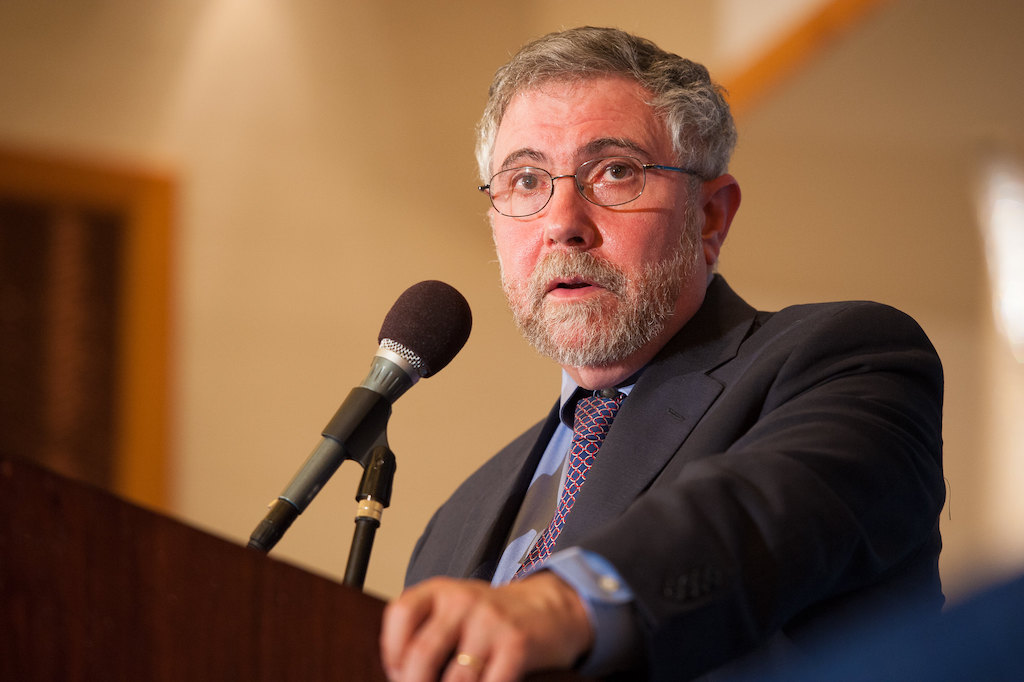
Paul Krugman speaking at the Commonwealth Club of California in San Francisco, May 2012. Ed Ritger / Flickr.
Paul Krugman, long associated with the push towards universal healthcare in the United States, doesn’t think Democratic presidential candidates should be running on Medicare for All in 2020.
Writing recently in the New York Times, the prominent liberal economist and columnist echoed a familiar (and bogus) critique charging that M4A is politically infeasible because it will force people off their current employer-provided plans. Elsewhere, Krugman has been aggressively discouraging a full-on push towards a single-payer system — warning, among other things, about its cost and the “problem” with “progressive purists” turning it into a “litmus test”.
To some, Krugman’s posturing may look like a flip-flop. Many, after all, will remember that he devoted large sections of his 2007 treatise The Conscience of a Liberal to aggressive advocacy for a universal healthcare system. Fewer are likely to recall that, then as now, Krugman’s prescriptions came with a pretty major qualifier: namely that a single-payer system, though preferable in theory, would be too politically contentious and was therefore an excessively ambitious goal.