Liberalism’s Hollow Partisans
In 2016 we learned that for some liberals, the best time to push for fundamental change is never. In 2020, we can expect more of the same.
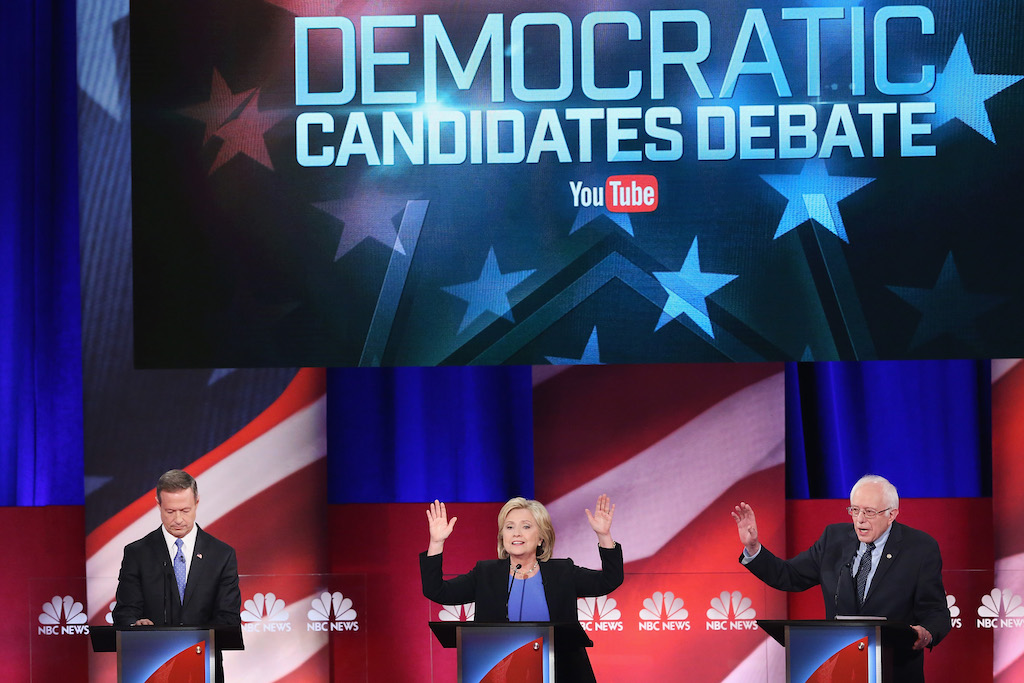
Martin O’Malley, Hillary Clinton, and Bernie Sanders at the Democratic Candidates Debate in Charleston, South Carolins, January 17, 2016. Andrew Burton / Getty
The 2016 primaries produced an unusual dilemma for those accustomed to setting the parameters of acceptable liberal opinion in American politics. Marginal and demoralized for decades, left politics suddenly came roaring back thanks to Bernie Sanders — whose popular message struck a resounding chord within the Democratic base despite the centrist preferences of the party’s establishment.
What were the guardians of liberal opinion, so used to dictating what ordinary voters were allowed to expect and demand, to do?
Liberalism Inc. never quite settled on a unified answer, cycling instead through an endless series of meta-arguments for why Sanders and/or his policies, popular as both were, were ill-suited to Democratic Party and the country. The arguments are too numerous to list, but many shared the same basic feature: nominal endorsement of Sanders in principle coupled with outright rejection of him in practice.