From the Union Hall to the Church
Jair Bolsonaro's election in Brazil marked the decline of trade unions as the primary site of working-class organization; and the rise of Evangelical churches in their place.
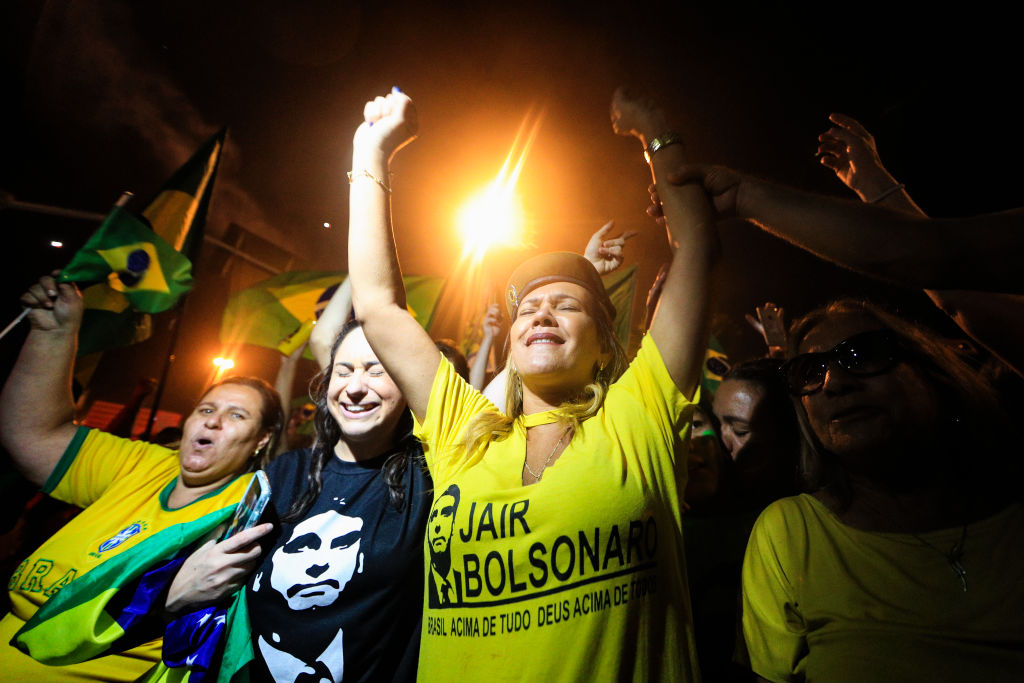
Supporters of far-right presidential candidate Jair Bolsonaro, celebrate in front of his house in Rio de Janeiro, Brazil, after he won Brazil’s presidential election, on October 28, 2018 in Rio de Janeiro, Brazil. Buda Mendes / Getty Images
Jair Bolsonaro, since winning the presidency in the most unpredictable election in Brazilian history, has been striving to end an era where citizens combined material progress with social protection. His government has already eliminated the Ministry of Labor, weakening the institutions responsible for labor regulations, like the Public Ministry of Labor (MPT) and the Labor Court. In addition, he proposed a strengthening of previous president Michel Temer’s counter-reforms, such as the labor reform and the law on the ceiling of public expenditures (a law that froze public spending for twenty years). Bolsonaro’s government will create a new “green-and-yellow” work card, replacing the “blue” one, without any of the labor guarantees provided by the Consolidation of Labor Laws (CLT).
The worker who “opts” for the green-and-yellow card would be subject to direct negotiation with companies, with no mediation by unions. This worker could possibly have constitutional rights, such as paid leave and Christmas bonus, suppressed in the negotiation process. The pretext is always “job creation.” Now that a year has passed since Temer’s initial counter-reforms, we can assess whether this repression of labor rights has indeed led to more jobs.
The data in this regard is damning: in February 2019, the unemployment rate was 12.4 percent, totalling 13.1 million unemployed, versus 12.5 percent in January 2017. Despite the slight increase in the number of employed workers, it is worth noting that most of these new occupations were generated within the informal labor market, where there was an increase of 528,000 people working independently and 498,000 employees from the private sector without work cards. In addition, the rate of under-utilization of the workforce — workers who could be working longer hours — reached 24.6 percent, with 27.9 million people in this group. This contributed to stagnating wages across the board in 2018. Meanwhile, the new ceiling of public spending bill did not prevent deterioration of the public sector net debt amid the slowest economic recovery in Brazilian history.