MMT Is Already Helping
In a response to Doug Henwood’s critique, Pavlina Tcherneva makes the case for the analytical power and political potency of of Modern Monetary Theory.
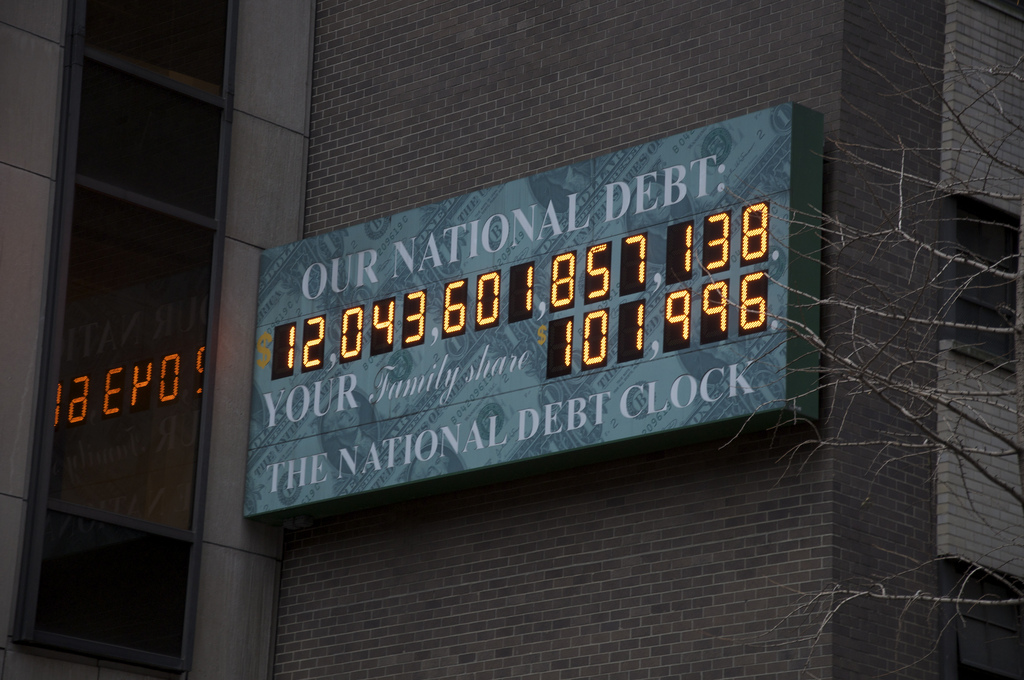
The “National Debt Clock” in New York City, an anti-deficit propaganda showcase sponsored by the Durst real estate company. Nick Webb / Flickr.
I was looking forward to reading Doug Henwood’s piece and the chance to respond to what I was sure to be a hard-hitting analytical critique. I was disappointed. There is no there there and thus my reply will be short.
His critique amounts to guilt by association and the utterly distasteful insinuation that MMT scholars cannot be trusted and neither can their work. MMT developer Warren Mosler has long been an advocate for “euthanizing the rentier,” but that can be ignored because he is a hedge fund guy. Let’s also ignore that Beardsley Ruml is not the only Fed official who has corroborated key MMT claims. Abba Lerner’s technical analysis of bonds, interest rates, and government spending is not contingent on the particular historical moment after WWII. Randall Wray and Eric Tymoigne have offered probably the most thorough reply to Thomas Palley’s critique, but none of the substance of their response makes it into Henwood’s piece, only a caricature of their rhetorical style. The hit job on Wray’s scholarship (someone who has left an indelible mark on institutionalist and Post Keynesian thought) is particularly disturbing, and Wray has issued his own reply. There is not a word about the importance of Wynne Godley’s work to MMT, while one of the most prolific MMT authors — Bill Mitchell — barely makes a cameo appearance, perhaps so as not to rock Henwood’s mistaken view that MMT is a US-centric approach.
I was hoping to see some engagement with the analytical insights of MMT, but alas. You will learn from Doug Henwood that we have done the “elaborate arithmetic of bank reserves,” but that reserve accounting is apparently of “limited relevance to anyone concerned with big-picture economic questions,” as if how the government funds itself is not one of them. Henwood can’t or won’t tell us what he thinks is wrong with our analysis. He simply says that we are wrong.