The Schism Is Finally Here
Pushed by leftist activists and legislators like Rashida Tlaib, the Democratic Party is finally having it over Israel. It's a long-overdue step toward shifting US foreign policy and challenging Israel's occupation.
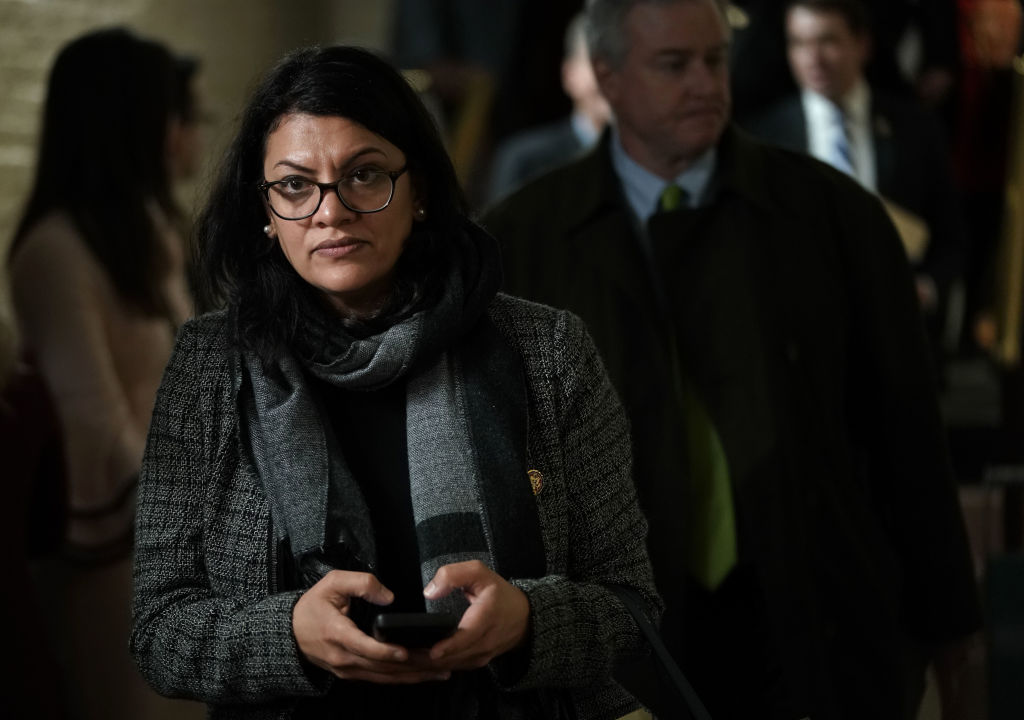
Michigan representative Rashida Tlaib leaves after a caucus meeting at the US Capitol on January 9, 2019 in Washington DC. Alex Wong / Getty
Shortly after their election this past November, a number of freshman left-wing congressional Democrats announced that they would not be embarking on one of Washington’s most sacred rites of passage: an American Israel Public Affairs Committee (AIPAC)–organized trip to Israel. These trips, which cost AIPAC around $10,000 a person, are essential instruments of the country’s largest pro-Israel lobbying group. They present an illusion of political moderation (the politicians meet with a handful of AIPAC-selected Palestinians) and gesture at a forgotten tradition of bipartisan Beltway consensus.
Michigan representative Rashida Tlaib, the freshman most vocal about AIPAC and the Israeli occupation of Palestinian lands, and herself a Palestinian-American, went a step further this week. She aims to organize an alternative congressional delegation to the West Bank, completely unattached to AIPAC. In response, New York representative Eliot Engel, the Democratic chairman of the Foreign Affairs Committee and a staunch AIPAC loyalist, told journalists that “instead of [Tlaib] talking about things, she’s new here, she ought to listen and learn and open her mind and then come to some conclusions.” Tlaib, in turn, invited Engel to join her in Palestine.
For years, observers have speculated about when the Washington bipartisan consensus on Israel would crack; in a 2014 New Yorker piece on AIPAC, Connie Bruck noted an emerging “schism” between American Jews that posed a threat to Washington’s longstanding pro-Israel consensus. That “Great Schism,” as Jonathan Weisman of the New York Times recently described it, is now in full bloom, and it extends far beyond just the communal politics of American Jews.