The Mexican Presidential Inauguration
AMLO takes the reins of a traumatized Mexico. He'll be fighting for vital reforms, but much more is needed.
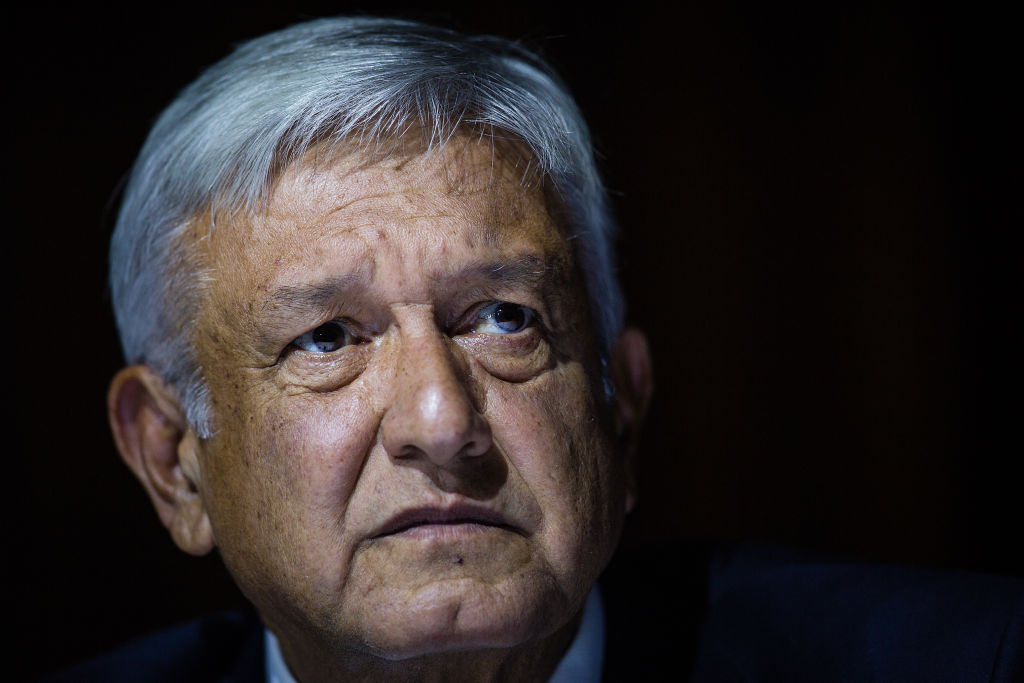
President-elect of Mexico, Andres Manuel Lopez Obrador, during a press conference to announce Marcelo Ebrard’s appointment as Minister of Foreign Affairs at Salon D’Luz on July 5, 2018 in Mexico City, Mexico.Manuel Velasquez / Getty
On Saturday, December 1, five months to the day after his thumping electoral victory, Andrés Manuel López Obrador (AMLO, as he is known for short) will take the oath of office at the San Lázaro Legislative Palace in Mexico City to become the president of Mexico for a six-year term. His ascent to power is historic by any measure: at a time when the Latin American Pink Tide is receding vertiginously from the historical shore, AMLO led his fledgling party Morena — founded only in 2014 — to a crushing landslide, defeating his closest rival by some thirty percentage points. In contrast to his previous presidential bids, where his support was concentrated in the center and south, AMLO swept thirty-one of Mexico’s thirty-two states, including the entire border area and even the industrial center of Nuevo León. In Congress, Morena holds an absolute majority in the lower House of Deputies and, together with its coalition partners, a comfortable margin in the Senate, as well.
From a historical perspective, AMLO’s electoral achievement stands out as even more remarkable. After seventy-one years of the post-revolution “perfect dictatorship” of the Institutional Revolutionary Party (PRI), the failed democratic transition of 2000, and the docena trágica (tragic dozen) years of rule by the conservative National Action Party followed by a one-term return to the PRI, the 2018 Morena landslide marks the first time a progressive party has won the presidency in modern political history, the first time it has won the Congress — and, needless to say, the first time it has done both together. In a system where a disproportionate amount of power remains concentrated in the presidency, AMLO’s triumph would appear, at first glance, to be total.
Playing a Bad Hand
AMLO, however, will need every inch of advantage to play the supremely difficult hand he has been dealt. Mexico’s economy is currently growing by just over 2 percent, while inflation is running at double that. The peso has shed half of its value against the dollar under the outgoing administration of Enrique Peña Nieto, falling from under thirteen to over twenty. Public indebtedness is set to crack the ten trillion-peso mark, rising 12 percent in the Peña years in relation to GDP. The state-owned oil company PEMEX, motor of the twentieth-century Mexican welfare state, has been privatized, allowing familiar names such as Shell, Repsol, and Chevron to scoop up contracts for deep-sea oil exploration. Inequality is rampant, with a handful of super-wealthy — many of whom, such as telecommunications magnate Carlos Slim, owe their fortunes to the transfer of public entities into private hands — coexisting with a mass of 61 million poor making a hardscrabble living in Mexico’s post-NAFTA agricultural ghost towns or clustered in shacks on the hillsides around its major cities. The nation is more dependent than ever on the importation of basic foodstuffs such as rice and corn as well as gasoline, maintaining only five days’ worth of reserves if the United States were to choose to turn off the taps. Corruption, already endemic, has hit a peak under the kleptocratic administration of Peña Nieto, with up to 10 percent of GDP being frittered away.